Should You Read "The Science of Getting Rich"? Yes… but skip the first chapter.
The Science of Getting Rich tells you who it's for, right in the opening lines. It was written, Wallace Wattles says, "for the men and women whose most pressing need is for money; who wish to get rich first, and philosophize afterward."
Get rich first. Philosophize afterward.
You can learn a great deal about this book from that one sentence — both why it has inspired people for more than a century, and why I think its opening pages deserve your suspicion.
I still recommend reading it. I also think the way it has a deceptive core… but it's so popular because the book carries important grains of truth mixed in.
What is this book:
- Written in 1910 by Wallace D. Wattles — 17 short chapters, and not a long read
- It's in the public domain, so you never need to buy it: you can read the whole thing free or listen to the full audiobook on YouTube
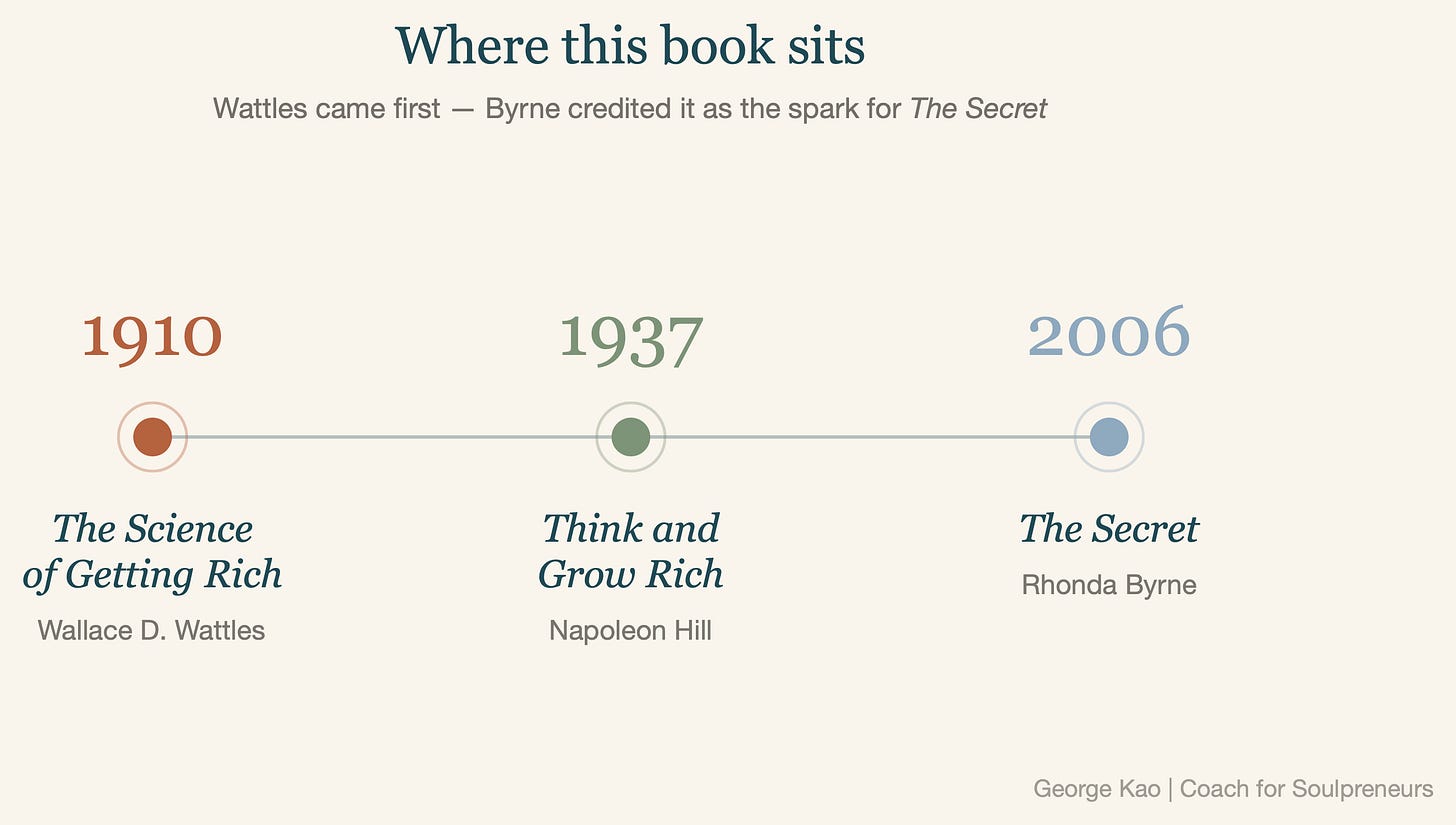
- It came decades before Napoleon Hill's Think and Grow Rich (1937), and Rhonda Byrne credited it as the spark for The Secret (2006) — which is why it's often called the grandfather of the Law of Attraction movement.
Why I'm putting my concerns first…
When I first wrote about this book back in 2018, I led with all the good parts and saved my concerns for the end.
I've come to think that was the wrong order. A reader who never reaches the bottom walks away with the inspiration and none of the caution. So now I've flipped it.
Where the book overreaches:
It calls itself a "science."
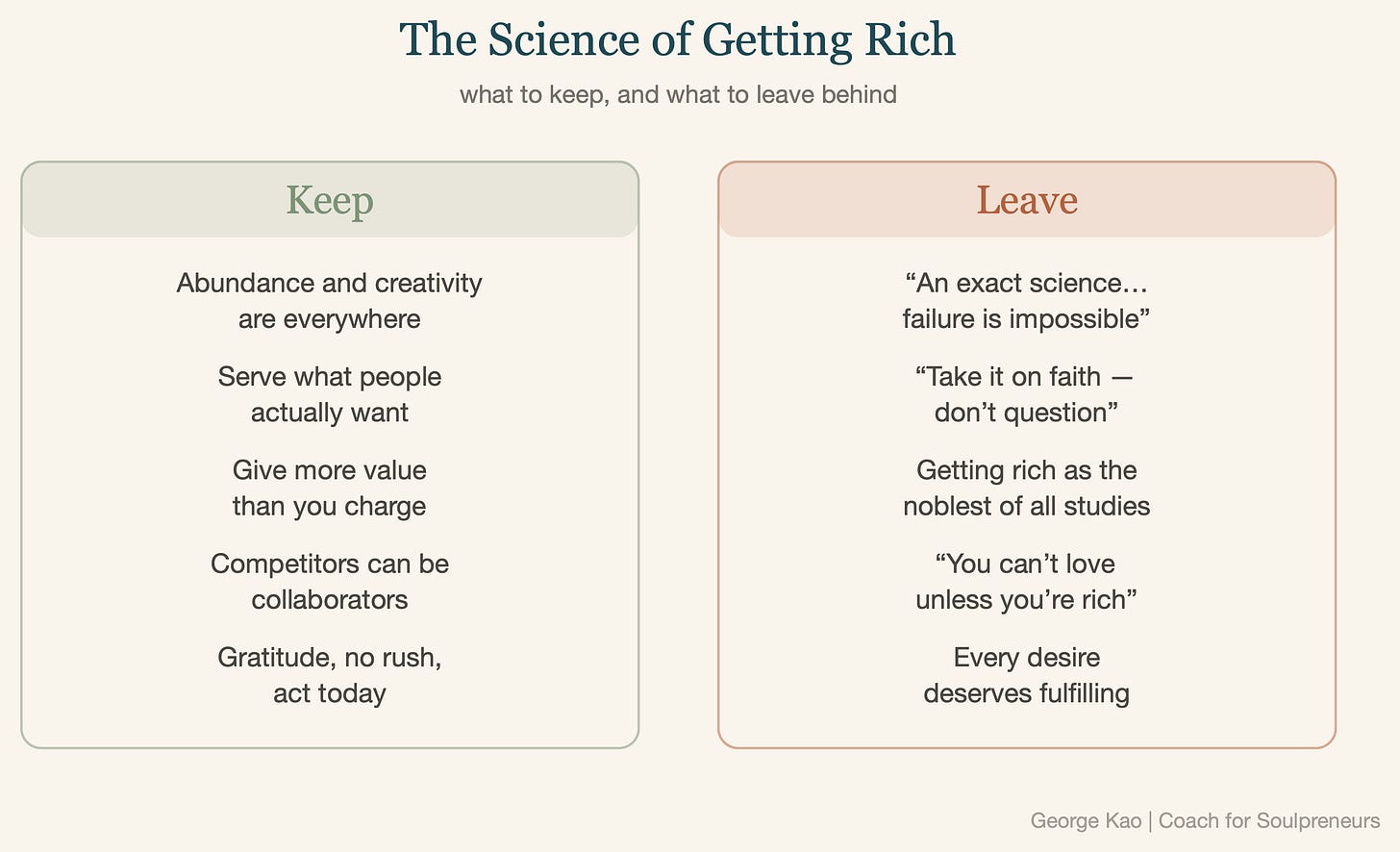
The author writes: "Every man or woman who does [what this book teaches] will certainly get rich; for the science herein applied is an exact science, and failure is impossible."
Follow the formula, he says, and with mathematical certainty you will become rich.
But the principles are vague enough that they can't be tested. So when you follow them and don't get rich, he can always point the fault back at you — you must not have followed it properly, or believed hard enough. A claim built so that it can never fail, isn't a science at all.
That flavour of certainty is how a great many dubious offers get sold to us. Supreme confidence, repeated often enough, is how people come to believe what isn't true. Some of this book's charm is simply repetition and volume.
Call these the principles of wealth. Call them ideas worth trying. Please don't call them a science.
It tells you not to question it.
"It is expected that the reader will take the fundamental statements upon faith…" And later: "Do not ask why they are true, nor speculate as to how they can be true; simply take them on trust."
It also suggests you stop reading other books on the subject.
That's what concerns me most. Anyone who tells you not to question them is exactly the person worth questioning.
Real growth will never look precisely like what any teacher says it should — including me. A good teacher offers principles, shares what they've seen go wrong, warns you off the paths that hurt them… and then says: but if you feel called to try it your way, go ahead. That may be your right path. A teacher who can't say that, is gathering followers rather than empowering students.
It says getting rich is the noblest study there is.
"It is perfectly right that you should give your best attention to the Science of Getting Rich, for it is the noblest and most necessary of all studies. If you neglect this study, you are derelict in your duty to yourself, to God and humanity…"
So the pursuit of money outranks ethics, philosophy, art, science, and spiritual growth. You owe it to God to become rich.
You can hear the modern prosperity gospel being born right there — the megachurch message that God wants you wealthy, with the inconvenient parts of Jesus set aside.
"But seek ye first the kingdom of God, and his righteousness; and all these things shall be added unto you." — Jesus, in the Sermon on the Mount
And the Eight-Fold Path of Buddhism — Proper Understanding, Purpose, Speech, Effort, Conduct, Vocation, Alertness, Meditation — somehow never gets around to mentioning lots of money.
Every tradition I know of says some version of: get right with your soul first… then build your material life from there. This book says the reverse, out loud, on page one.
It says you can't truly love unless you're rich.
"To live fully in soul, man must have love; and love is denied expression by poverty. The man who has nothing to give cannot fill his place as a husband or father, as a citizen, or as a man… It is therefore of supreme importance to him that he should be rich."
Read that chain again: you can't give unless you're rich, and you can't love unless you can give.
Of course, it isn't so. Some of the most generous, largest-hearted souls I've known have had very little money. Giving was never only about buying stuff for people.
One of my heroes is Peace Pilgrim, who walked across America more than 20 times, bringing love and wisdom to thousands of people along the way. She didn't have a penny to her name. Her audiobook is free, and it changed my life.
And across the many accounts of near-death experiences I've read (and listened to) over the years — including plenty from people with no book to sell and nothing to gain — one of the most common things they come back saying is that they became less materialistic... that a life organized around acquiring wealth is likely missing the point.
It treats every desire as holy.
"Desire is possibility seeking expression, or function seeking performance, and should be fulfilled."
There's a seed of truth in that. There usually is, which is what makes the idea slippery.
But does it mean every desire deserves fulfilling? There's the desire to overeat. The desire for far more than we could ever use. The desire to win by making someone else lose.
The book never argues against excess. It mostly praises it — including the notion that when the world's materials run out, human ingenuity will simply produce more. That may be partly true. It also hands out permission for a kind of consumption our planet is currently paying for.
What's genuinely worth keeping:
Now for the good — and there's a lot of it, which is why the book has lasted.
1. Anyone can become financially successful — with your eyes open.
Your background, your profession, your starting capital: none of it disqualifies you. If someone with a background like yours has made it financially, so can you. And if nobody like you has yet… perhaps you get to be the first.
The book, written in 1910, has no concept of privilege, and that's a real blind spot. Some of us carry a heavier load — because of race, gender, class, health, the family or the neighborhood we came from.
We can hold that truth, yet, still not build a fixed sense of self around it. When we argue for our limitations, we tend to get more of them, simply because that's where our attention lives. Both can be true at once.
2. Creative potential is everywhere.
The book describes a formless, intelligent substance filling all the empty space in the universe — available to anyone, at any moment, to draw new ideas and solutions from.
I'll share my own translation, and you're welcome to disagree. I think one way of understanding God is like the Force — the all-powerful energy of love and intelligence and goodness pervading every particle in the universe. Which means creativity is with you wherever you are… however stuck or broke you might currently feel.
This is also why the book warns against believing too much in current appearances. We look at our situation and we often wrongly assume that it's permanent — that our work will always be this hard, or our income always this sparse. But someone looking at a field of weeds can also envision a garden there. Everything is always changing… and we have far more influence over those changes than we usually think.
3. Serve what people actually want.
Your income comes from other people's spending. So it helps enormously to offer something people are already looking for, in an area that seems to be growing. (Google Trends makes this research free, which Wattles could only have dreamed of!)
The flip side: if you had a peak experience, or trained deeply in a modality few people are seeking, that path can still be beautiful — it may just not be the thing that pays you. Do the work you have talent for, or talent you're passionate enough to build.
4. Give more value than you charge.
This one has become mainstream business advice, but remember it's a hundred years old.
Whatever your price — low or high — the question is whether your customer walks away feeling it was an excellent deal. When they do, they tell people. And word of mouth remains the best marketing there is.
5. Your competitors are not actually your competitors.
This is still my favorite idea in the book.
Most business stress comes from a competitive mind: if they win, I must have lost. But consider the hardest possible case — someone offering the same service, to the same people, in the same town, at the same price. Even they can be a potential collaborator.
What if you pooled your efforts and did better marketing together, so that more people learned about your collective niche — growing the pie rather than fighting over one slice? What if you each found where the other was strongest, and built something drawing on both? I've written about this concept of nichemates as our best partners.
6. Gratitude, no rush, and doing what you can today.
Be grateful for everything, including the failures — those are the moments that actually motivate us to try something different. (Success tends to make us complacent!)
There's no need to hurry, either. If someone else took your idea and actually implemented it… that means they did the work. Ideas are only seeds. You can hold a seed in your hand forever; the person who planted it in good soil and tended it carefully, is the one who deserves the harvest.
So let the past be the past. Do what you can now. I've come to trust that there's such a thing as divine timing — our work is to keep showing up and keep growing… and it's life's job to bring the results when it's time for us to receive them. That's much of what I mean by being strict about showing up, and lenient about the results.
The one principle I'd hand back:
The book tells you to spend your leisure hours turning your vision over and over, until you've memorized every detail. Working on the business, or picturing the business — always one or the other.
Read that again and something familiar shows up — hustle culture. Total obsession, presented as devotion.
I understand the mechanism. Fill your mind with the vision and you'll start noticing opportunities you'd have walked past. That much is true.
But a life with no spaciousness — no rest that belongs to you, no hours that aren't in service of the business — isn't a life I'd wish on any soulpreneur. Keep the clear vision. But keep your weekends too.
What I think the purpose actually is…
My deepest disagreement with this book took me years to be able to say simply.
The purpose of life is growth.
Not riches, and not 'success' — though you may have both, and I hope you do, if it's your best path of growth. Underneath all of it, the purpose I keep finding is to become: a better human being, a better soul, a better friend, colleague, family member.
Which means building a business is a spiritual practice as much as a financial one. It's one of the more reliable ways I know to be shown, repeatedly and kindly, exactly where you still have growing to do.
And I can offer one piece of evidence now that I couldn't have offered when I wrote an earlier version of this article...
In 2018 I was making a decent living from my business — I have been since 2010 — but I couldn't have predicted where I'd be today. Since then, I've reached financial independence. Working for money is now optional.
But I didn't get there by treating money as the noblest of all studies. I got there the slow way: serving people I care about, charging fairly, spending less than I earned, and refusing to hustle myself into the ground. The Middle Way of Authentic Business — between "wait until you're ready" and "grind until you break" — turns out to be quite effective.
So when Wattles says you must get rich first and philosophize afterward… I'd offer my own life as a small counter-example. Philosophizing first didn't cost me the money. I suspect it's part of what has created the sustainability.
So… should you read it?
Yes — with one caution.
Skip the Preface and the First Chapter. Nearly all the overreach lives there: the "exact science," the demand for unquestioning faith, the claim on your soul. Start after that, and what remains is a useful book about abundant, creative thinking — the kind that helps a discouraged person believe a different future is available to them.
Take the abundance, and leave the money-worship behind.
A few questions people ask about this book:
Did it influence The Secret? Yes — directly. Rhonda Byrne credited The Science of Getting Rich as the spark for her 2006 film, describing how moved she was reading it.
When was it written? 1910, by Wallace D. Wattles.
Is it in the public domain? Yes. You can read the whole thing free or listen to the full audiobook on YouTube.
How does it compare to Think and Grow Rich? It came 27 years earlier, and it's shorter and more mystical. Hill's book is more practical; Wattles' is more metaphysical.
Is it worth reading if I'm not interested in the Law of Attraction? I think so — as long as you read it as one person's inspiring, flawed, century-old argument… rather than as a formula with a guarantee attached.
If you've read this book, I'd love to know which principle rang true for you… and which one didn't sit right. See you in the comments section!
And if you'd like more of my thoughts on relating to money well without worshipping it, my best posts are on my Healthy Money page.
May you build a business that truly grows your soul, as much as it grows your income. 🙏🏼🧡
This post was originally written in 2018, refreshed in 2026.
Visit the comments section here (and feel free to add yours!)