The 7 Practices of Thriving Soulpreneurs
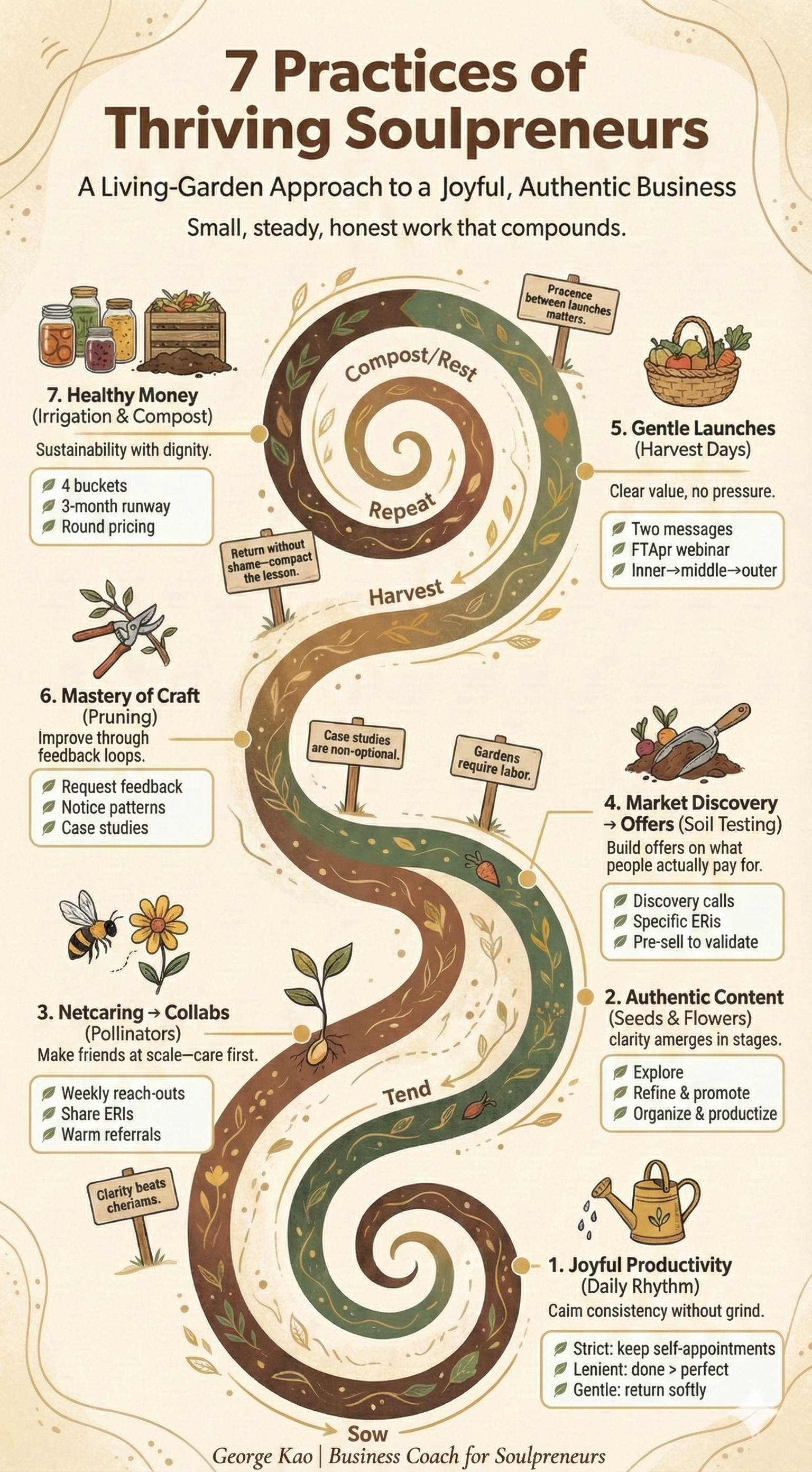
A Living-Garden Approach to a Joyful, Authentic Business.
Introduction:
A garden is cyclical, alive, relational. No finish line — just seasons of sowing, tending, harvesting, and composting. Each month, quarter, and year is a new loop of Spiral Learning, where small, steady, honest work compounds into clarity, income, and impact, while staying true to a heart of ministry, friendship with your audience, and joyful service. 🙏🏼
The 7 Practices are the ongoing rhythms of an authentic business — to return to weekly, monthly, quarterly, year after year.
But before we plant the first seeds, let’s look at the ground beneath our feet. For a soulpreneur, business isn’t just a set of tasks; it is a spiritual practice. These foundational values — our ‘soil’ — determine whether our garden will eventually flourish or become a source of burnout.
Guiding Ethos (The Soil)
Content is ministry and self-exploration. Share generously to serve others, and to discover your own authentic voice. Separate your content from your offers — refrain from sneaky CTAs (calls-to-action). Your message matters; the world needs your perspective in your voice. No idea is truly original — ideas exist in shared space; your job is to channel them via your unique expression.
Authentic marketing is like making friends at scale. It requires no funnels. Treat people as souls, not segments. Netcaring over networking.
Selling is inviting. Gentle, playful, pressure-free, and free of attachment to outcome.
Process over outcomes. Strict about showing up, lenient on results, gentle in refocus. Visualize the doing (to practice bringing joy to any action), not the having of outcomes. Focus on what you control (your practices, actions, consistency), not outcomes (reach, sales).
Tiny audience, great business. Depth over reach. Multiple rings of access for inclusivity: Concentric Circles Business Model.
Your energy signature is your brand. There’s no need to chase attention; be findable by being your best Self. Your unique expression of values, purpose, and soul’s vibration is your authentic brand.
Work is a spiritual practice. Every task is an opportunity to integrate virtue. Every client session is like service to the divine. Marketing itself is a vehicle for personal growth and ministry, not just client acquisition.
Law of Action. Feeling resistant? Honor the practice anyway. Feelings shouldn’t dictate action — acknowledge them, but don’t let transient emotions override lovingly-disciplined consistency. Forgive past actions, reparent your entrepreneurial self… and play! Law of Attraction manifests through Law of Action.
Focus on meaningful work now. Not obsession over “financial freedom” (creates grasping). Fulfillment is in the present: meaningful work + self-care, sustained over time.
With our ethos firmly rooted in the soil, we begin the daily work of tending. This starts with how we manage our most precious resource: our own energy and presence.
The Seven Practices:
1) Joyful Productivity
Keep yourself resourced, focused, and playful. Small, steady work done with lightness compounds into powerful business results over time.
Core Mantra:
- Strict: Keep self-appointments. “You’re a genius; you just need a timer!” Book Focusmate for accountability or join a George Kao Work Retreat.
- Lenient: Detach from results. Done, not perfect. “Half-ass it” to let go of perfectionism — create lightly, then let it be finished or published in service of others’ well-being and your own growth.
- Gentle: When off-track, return softly. Energy Reboots in just 30 seconds, practiced multiple times a day.
By balancing these three — the structure of the strict, the grace of the lenient, and the kindness of the gentle — we stop treating ourselves like machines and start treating ourselves like the living ecosystem we are. This internal harmony is what prevents the burnout so common in our industry.
Operating System:
- Hat Manuals: Simple, documented processes for each “hat” you wear in your business (Creator, Host, Launcher, Coach, Bookkeeper, etc.). Reduces decision fatigue, ensures calm work. Read more: What are Hat Manuals for a Soulpreneur?
- Time Tracking: One week every 3–6 months. See where time actually goes (vs. guessing). Optimize toward True Productivity: real interactions (discovery calls, content replies) > busywork (tweaking website). Read more: What is true productivity for the soulpreneur?
- Playfulness as Strategy: Track a Joy KPI (1–10) for key tasks. Work is a game/stage for play and growth, not meant to be a grind. Practice consistently leveling up your joy, which is available in any and every activity.
- Intention Ritual: Before each session: “What is my MIT (most important thing) now? What spirit word am I keeping in mind (and embodying)? When will I take a break?” Then set a timer and start working with joyful productivity.
- Capture All Ideas: Keep one running list (notes app). When creating, just pick an idea that resonates — no need to brainstorm from scratch. Practice CCC (Capture, Categorize, Calendar).
Quarterly Reflection on Your Practices:
Every 3–6 months, review each of the 7 practices:
- What’s working well with this practice?
- What feels clunky or draining?
- How might I improve or simplify this?
Ideally, reflect with the support of a coach who can offer outside perspective. This quarterly pause keeps your business garden healthy and evolving.
As you find your rhythm in joyful work, you will naturally begin to have insights and experiences worth sharing. This is where your garden begins to bloom for others to see — not as a sales tactic, but as a genuine act of service.
2) Authentic Content Creation
Explore publicly, serve sincerely, and let clarity emerge in stages. Each piece of content is a small act of service that compounds into trust, relationship, and business opportunities.
Three Stages of Content:
- Stage 1 (Explore): Low-effort, text-first for purer stats. Less editing for videos — just turn camera on, speak, and upload. No one remembers bad content (algorithm quickly buries flops!).
- Stage 2 (Refine & Promote): Turn resonant posts into a short video, carousel, or mini-lesson.
- Stage 3 (Organize & Productize): Webinars, guides, courses, service packages.
This three-stage process is the antidote to the ‘perfectionism’ that keeps so many brilliant ideas in the dark. We allow our thoughts to be ‘seeds’ first (Stage 1) before we ever expect them to be a ‘full harvest’ (Stage 3). It gives us permission to be messy in public, which is where true authenticity begins.
Principles:
- Create for one caring person (friend, ideal client). Social media as karma points: deposit goodwill daily.
- Post on multiple platforms (1 main + 1–2 satellites). How to choose which platforms? Be where your true fans are. Make it easy to find you.
- Daily Idea List (10 light ideas). The practice builds your idea-generation muscle. Practice Idea Alchemy: break ideas into pieces, combine/contrast for fresh frames, thoughtfully critique popular advice.
- Use AI as a co-partner for clarity, not as your voice. Don’t worry about sharing your IP with AI — contribute to the shared knowledge space, humanity’s wisdom.
But your voice shouldn’t exist in a vacuum. A healthy garden relies on companion planting — the relationships and collegial connections that support your growth as much as you support theirs. We call this Netcaring.
3) Netcaring → Collabs
Genuine collegial care creates referrals, collaborations, and fulfillment. Small, steady relationship-building compounds into a network of mutual support and warm leads.
Practice:
Netcaring reach-outs each week: appreciation, swap insights, light collab ideas. Connect from genuine care and enjoyment, not “what can I get?” Read more: The 5 Levels of Netcaring.
Share your ERIs (easily referrable issues, aka Client Doorways) so it’s easy to refer you; learn your colleagues’ ERIs as well so you can refer them. Collaboration over competition.
Keep it enjoyable :)
Outcome:
Tiny audience, great business via warm referrals and shared events.
Through these conversations and your public sharing, you will start to hear the heartbeat of your community. You’ll begin to notice what they truly need and what they are ready to invest in, allowing you to co-create offers that are deeply aligned with their reality.
4) Market Discovery → Aligned Offers
Listen for what people actually pay for. Co-create the offers you love to deliver.
Market Discovery Calls:
Caring conversations (not sales). Ask them: What have you paid for to solve this? What disappointed you? What would be “an easy yes” at $X?
Think of this not as ‘data collection,’ but as deep listening. When you understand the language of your soul-clients’ challenges, your marketing stops feeling like ‘convincing’ and starts feeling like ‘reflecting.’ You are simply holding up a mirror to their own needs.
The work of Market Discovery helps you ground your offers in real-world demand (what people actually spend money on), not vague “what do you want?” questions.
ERIs: Easily-Referrable Issues
Craft clear, specific “doorways.” Niche your offers, not yourself (keep identity broad, multi-passionate if you like). Create specific, clear offers for different needs. You are the gardener, yet garden beds vary by season.
Build-While-Selling (Pre-Sales):
Share the gist. If 3+ deposits from 10–20 warm invites, run it live and shape modules with the cohort. If not, refine and try again.
Pre-sale invitation template: “I’m piloting [program] to help [who] go from [pain] to [small, real outcome] in [timeframe]. Founding price $[round]. We’ll co-shape modules live. 6 spots. Want details?” Be sure to re-write to your own voice and goals.
Ongoing Clarity:
You discover more about yourself and what you want to deliver by offering different things. Each experiment teaches. Each season reveals. Small, steady experimentation compounds into offer-market fit.
5) Gentle Launches/Offerings
For some of us, the word “launch” might feel a bit aggressive. But in a living garden, a launch is simply an invitation to the harvest. You have tended the soil (Practice 1), grown the plants (Practice 2), and cared for the community (Practices 3 and 4). Now, you are simply opening the gate and letting people know the fruit is ready…
Two-Message Launch Cadence (Example) –
- Message 1: Early bird is open (benefits + features + price with no-charm pricing).
- Message 2: We start next week (remind benefits, logistics, who it’s for).
Send to email list and post on all socials. That’s it.
It only requires two gentle invitation messages posted to your audience wherever they are. Clear value. No pressure.
You might also integrate a launch with webinars…
FTApr Webinars:
Free To Attend, Paid Recording. 60 minutes. 85% teaching, 15% invitation.
Circles of Enrollment for your offer outreach:
- Inner circle first: Personally invite your closest colleagues, past clients, and trusted friends to spread the word, and if they’re interested themselves, to claim the spots to your offer. They get first access and feel honored.
- Middle circle next: Email your list. Those who’ve raised their hand to hear from you.
- Outer circle last: Public posts on social media. The opportunity is now open to all.
This sequence honors relationship depth, creates natural urgency, and feels generous rather than pushy.
6) Mastery of Craft
Excellence through feedback loops and client impact. Small, steady improvements in your craft compound into mastery and exceptional client results.
The Practice:
You’re committed to becoming excellent in your craft. Engaging with other people’s workshops, courses, books, and doing your own journaling all help… but the most grounded path to excellence is noticing the impact your work makes on your clients, and adjusting based on those observations.
Create a feedback loop from every product/service delivery. What’s working well, according to your clients? What can be improved?
Gathering Data:
- Request feedback (both positive and constructive) after every completed session, course, program.
- Sometimes you’ll get glowing testimonials that encourage you and help your marketing.
- Sometimes you’ll get honest feedback about how to improve. Take special note when multiple clients share the same type of feedback.
Case Studies:
Create formal client case studies throughout the year (target: 5/year).
They give you clarity about which aspects of your services are most impactful, what kinds of clients work best with you and for what issues and contexts.
They serve both your own learning and your marketing/sales efforts.
Sub-Practices:
- Request feedback after every completed engagement.
- Continually work on client case studies.
- Quarterly review: What patterns emerge? What adjustments should I make?
As your mastery grows, so does the value you provide. It is only natural — and healthy — that the financial ‘irrigation’ of your business grows in proportion to the shade and nourishment you provide to others.
7) Healthy Money
Financial clarity as spiritual practice. Sustainability is a basic necessity — if it’s not sustainable, you’ll quit, negating all success.
Consider creating four accounts or financial buckets:
Revenue In → Allocate to: Profit/Owner Pay (personal expenses), OpEx (business operational expenses) ideally 3 month runway, Tax (estimated), and Savings and Investment.
Review accounts weekly (15–30 minutes).
Pricing with Dignity:
No charm pricing (no prices like .47, $95, $997). Round numbers you’re proud of signal authenticity and transparency.
Compounding Mindset:
Small, steady investments in skills, assets, and relationships compound like an orchard. Think long-term: $500 invested monthly in a strong asset like Bitcoin or S&P500 for 15% annual return can turn into $374,000 after 15 years! How I invest my money. The same happens with your skills: invest in them regularly and observe the improvements.
These seven practices provide the rhythm, but as any gardener knows, nature can be unpredictable. To help you navigate the ‘weeds’ of resistance and the ‘droughts’ of slow seasons, here is some honest Truth-Telling from the field.
Truth-Telling
On Launches and Presence:
Two messages only work if you’re consistently present between launches. Ministry first, invites second. If you disappear for months then suddenly pitch, it lands like a cold email. Your offers are more likely to enroll well when they’re natural extensions of ongoing service and friendship with your audience.
Circles of Enrollment break down if your inner circle doesn’t know what you actually do. Netcaring isn’t transactional — you must genuinely show your care, not just wait for them to buy.
On Audience Size and Proof:
Tiny audience requires clear ERIs (easily referrable issues) and strong proof. Case studies are non-optional. If you have 200 people on your list and vague promises, you’ll get vague results. Specificity and social proof do the heavy lifting when you don’t have volume.
If you’re not getting deposits on pre-sales, the problem is rarely your personality. It’s usually: (1) the promise isn’t specific or believable enough, (2) you invited people who don’t have that problem, or (3) your warm relationships aren’t actually warm yet.
On Boundaries and Busy-Work:
Netcaring without boundaries becomes procrastination. Cap hours; track referrals/collabs. If it’s not creating a sense of genuine connection, or tangible opportunities within weeks, it may just be networking theater.
Hat Manuals and systems can become another form of resistance. Build them in service of delivery, not in place of it. If you have many hat manuals but no clients for a long time, you’re organizing an empty house.
On Webinars and Clarity:
If webinars don’t enroll clients, the issue is usually topic/ERI clarity, not your charisma. A boring, clear webinar enrolls better than an exciting, vague one. Ask: would someone pay $20 just for the recording? If not, your teaching needs more actionable depth.
Attendance dropping off? Your audience doesn’t trust that you’ll deliver value in the time you’re asking.
On Feedback and Ego:
Asking for feedback feels vulnerable. Do it anyway. Your best clients want to help you grow. But beware: early clients sometimes give advice that reflects their personality, not your market. Look for patterns across at least 3 people, not isolated suggestions.
Case studies feel like extra work until you realize they’re your fastest path to clarity. If you can’t articulate what changed for someone, you don’t yet understand what you’re selling. Write the case study before you write the sales page.
On the Work Itself:
This is a subtle but vital distinction. Joyful work doesn’t mean ‘effortless’ work; it means work done with a heart of play rather than a heart of grasping. We pull the weeds because we love the garden, not because we are afraid of what happens if we don’t.
Your offers will evolve. What you think you’re selling in Month 1 is rarely what you’re actually delivering by Month 6. Stay curious. The market is teaching you about yourself if you’re willing to listen.
On Cycles and Seasons:
This is a practice, not a performance. Some months will feel generative; others will feel fallow. Both are necessary. The compounding happens when you stay present through the slow seasons, not by grinding harder.
Spiral Learning means there’s no “behind.” If you skipped a month, you didn’t fail — you composted. What did that pause teach you? Return to the practice without the shame story.
On Authenticity and Ethics:
Choose genuine connection over grabby lead magnets and inauthentic “pain point” manipulation. This attracts aligned clients. Forgive yourself for less-authentic/ethical early marketing days — we’re all human. With reflection, we grow and find better ways forward.
Authenticity over tactics. Always.
Closing: The Compounding Garden
A garden doesn’t grow through heroic bursts. It grows through small, steady, honest work — watering when it’s dry, weeding when things get tangled, harvesting when the time is right, and resting when the season calls for it.
Your business is the same. Each piece of content is a seed. Each netcaring conversation is companion planting. Each discovery call tests the soil. Each gentle launch is harvest time. Each case study enriches future growth. Each financial review ensures the irrigation system works.
The living-garden approach is not a ‘get rich quick’ scheme; it is a ‘stay fulfilled forever’ strategy. There will be seasons where the weeds seem to grow faster than the flowers, and seasons of surprising, effortless abundance.
Your job is not to control the weather. Your job is simply to return to these 7 practices with a heart of service and a spirit of play. If you keep tending the garden, the garden will — in its own perfect timing — always take care of you.
Which of these practices feels like it needs the most ‘watering’ in your business right now?
Visit the comments section here (and feel free to add yours.)
