Soulpreneur, You’re Being a Little “Delulu”… and that’s a Good Thing :)

Over the years, a lot of soulpreneurs have recounted to me a conversation they have with loved ones. It happens at the dinner table, or in the car, or in a text thread they keep rereading. A caring family member or close friend says some version of:
Maybe it’s time to be realistic about your “business”…
I know that conversation too well. To this day — 17 years after I’ve been making a full-time income in my business — my parents still aren’t clear what I do (it’s outside their understanding of what a “normal career” is) and so, they still doubt my ability to support myself, even though I’m sending them money every month to support them!
Some of you reading this can relate. It’s a split feeling. Part of you wonders if they’re right. Yet, part of you also knows that, of course since they haven’t lived your life, they don’t understand your mission, and they don’t trust your capabilities in the way that you do. The mainstream story says: hey, let’s face reality…get a job!
The truth is that many of the successful practitioners you admire have spent five, ten, fifteen years in this exact phase that you’re in now…
So, this post offers the case for persisting as a soulpreneur. What looks like delusion (from the outside) is often, actually, the most rational stance available to those of us who are building true livelihoods long-term.
First, let’s grant the hard part…
Let’s begin with your family’s concerns, so that we can make a trustworthy case.
It’s true that the success rates are brutal. In one classic study of nearly three thousand entrepreneurs, 81% put their odds of success at seven-in-ten or better. About a third said ten out of ten! Sadly, the real survival numbers are nowhere near that. Part of what drives the gap, researchers find, is that we compare ourselves to some generic person starting a business, rather than to the actual field we’re walking into.
And there’s survivorship bias stacked on top. For every Brené Brown we can name, there are thousands of equally devoted practitioners who held the same beliefs (and perhaps had almost the same talent) yet, quit broke. We typically only see the ones who made it. We don’t see the ones who don’t. Any article that ignores this is just propaganda.
Importantly though, it isn’t the whole picture!
What accurate forecasting can’t do
A mind that forecasts accurately, that assumes the high failure rates in entrepreneurship, decides to not start anything…
Decades of research on what psychologists call “positive illusions” suggest that a persistent optimism is essential to how mentally healthy people function.
About 80% of us carry that persistent optimism (including probably you and me both!). It correlates with creative work, not with delusion in any clinical sense. Studied as a group, entrepreneurs score meaningfully higher on optimism than non-entrepreneurs.
Seligman’s well-known study of insurance agents found that the more optimistic half outsold the rest by 37% in their first two years! The difference was in how they explained their setbacks to themselves.
So if 81% of entrepreneurs overestimate their odds, and that miscalibration is a big part of why anything meaningful gets started at all… then optimism starts to look like the price of admission for meaningful work.
The accurate forecaster? They see the odds clearly… and very often, they never start anything.
Forecasting is the wrong tool
We can keep arguing about which forecast is more accurate, the optimistic one or the pessimistic one. And the whole time, we’ll miss that forecasting itself is the wrong tool for us.
The researcher Saras Sarasvathy studied how expert entrepreneurs think, and found they don’t reason the way business schools teach.
Business schools teach causal logic: predict the future, set the goal, analyze the competition, maximize the expected return.
Expert founders, working under real uncertainty, use what she calls effectual logic instead. They start with who they are and what they can afford to lose, and they shape a future rather than predicting one.
When she compared experts to novices, this was the clearest difference: the experts leaned far less on prediction, and far more on what they could control. She wrote:
“To the extent that we can control the future, we do not need to predict it.”
The future of a meaningful practice isn’t sitting out there waiting to be forecast. It’s being co-created, with each piece of writing you publish, each conversation with a colleague, with each new client you work with. There’s no accurate forecast available, because the thing you’d be forecasting doesn’t exist yet. You’re still co-creating it.
Effectuation offers five principles, and they map well onto soulpreneur work:
- Start with what’s in hand. Begin with who you’ve become, what you know, and who you know. Then ask what you can make next with that. Start with your fascination.
- Work from affordable loss. Before you begin something, name what you’re genuinely willing to lose if it doesn’t work: what kind of money, time, energy, nervous-system bandwidth. This is your safeguard against bet-the-farm delusion. Practice healthy money principles.
- Build from real commitments. Rather than analyzing your competition, gather actual people: early clients, peers, collaborators, the ones who say I want this. The market grows out of those relationships. Practice authentic market discovery.
- Use your surprises. A launch that flopped still told you something true about what people want. Treat all surprises as information you get to use. There’s no failure, only redirection.
- Stay the captain. Put your attention on what you can steer (conversations had, invitations made, offers launched, skills deepened) and let go of what you can’t (the algorithm, the timing, your family’s understanding).
Optimism gives you the courage to step into the uncertainty. Effectuation gives you a way to move through it without pretending the uncertainty is gone…
For a step by step plan, check out the 5 Levels of Soulpreneur Growth.
Why soulpreneurs especially need this
Lewis Hyde, in The Gift, describes two economies, the market economy and the gift economy, running on very different clocks. Healing, presence, transformation, deep listening: these are gift-economy creations, and we’re asking them to survive on market-economy time. Trust circulates a long while before it monetizes. (None of which is an argument for undercharging yourself into disappearance though! The real question is how the gift keeps moving without the giver vanishing.)
There’s also the plain matter of feedback speed. A pizza shop knows by week two whether it’s working. A grief practitioner, or a contemplative teacher, or a niche course creator, might not know for more than a year. The feedback is genuinely slow, which means a flat stretch tells you far less than your family assumes it does.
I think of the metaphor of the growth of a mycelial network. So much of this work happens underground, the body of work compounding in the depths, long before anything fruits above the surface. Your loved ones can see the fruiting bodies, the follower count, the revenue. They can’t see the network underneath.
Successful practitioners illustrate this. Joanna Penn wrote for years before she could leave her consulting job. Adriene Mishler posted her first yoga videos in 2012, long before the wider recognition arrived. These stories don’t prove anything, and they carry the same survivorship bias I named earlier. My own path looked like this too: a slow, unglamorous build, no viral moment (still waiting on that one!), just years of showing up. One more example that the long flat stretch is normal for soulpreneurs.
Where your family might be right
Once in awhile, they are ;-)
Three cautions that are worth our consideration:
The first is what researchers call the calling trap. Work experienced as a calling produces deep meaning, and it also makes people far more willing to tolerate underpayment, overwork, and self-abandonment. We soulpreneurs are precisely in this “high-calling” group. So it’s worth saying plainly: a calling is not automatically a business model.
The second is spiritual bypassing, using spiritual ideas to sidestep something that needs facing. “Everything happens for a reason.” “If it didn’t work, I wasn’t aligned.” The diagnostic question I keep close: does this spiritual frame help me face more of reality, or does it excuse me from part of it?
The third is subtler. Even grounded optimism, researchers find, seems to help most at the beginning of a venture and through the long low-feedback stretch. Later, once there’s real feedback to respond to, that same optimism can start to dull your sensitivity to it. The trait that helps you start can become the thing that keeps you from adjusting… so it’s worth knowing which stage you’re in.
And one note running alongside all of this: not everyone is wired for optimism, and that is not a defect. Some careful, anxious people do their best work by picturing exactly what could go wrong and preparing for it. If that’s you, you don’t need to manufacture cheer. You need a method… which is what the next section is for.
How to tell which one you’re in
This is the section that keeps the whole piece from being mere permission. The research is clear that sometimes the right move is to pivot, to rest, or to release.
The affordable-loss line. This one comes straight from effectuation: what was I willing to lose when I started this, and have I crossed that line? Run it across money, time, energy, health, relationships. If you’ve crossed a line you set for yourself, let that count. That’s your discernment working exactly as it should.
Learning velocity. Ask yourself what you’ve learned in the last six months that genuinely changed your offer or your approach. If you can name three real things, the work is still teaching you, and that’s a good sign. If you can’t name even one, the persistence may have become a way of not looking.
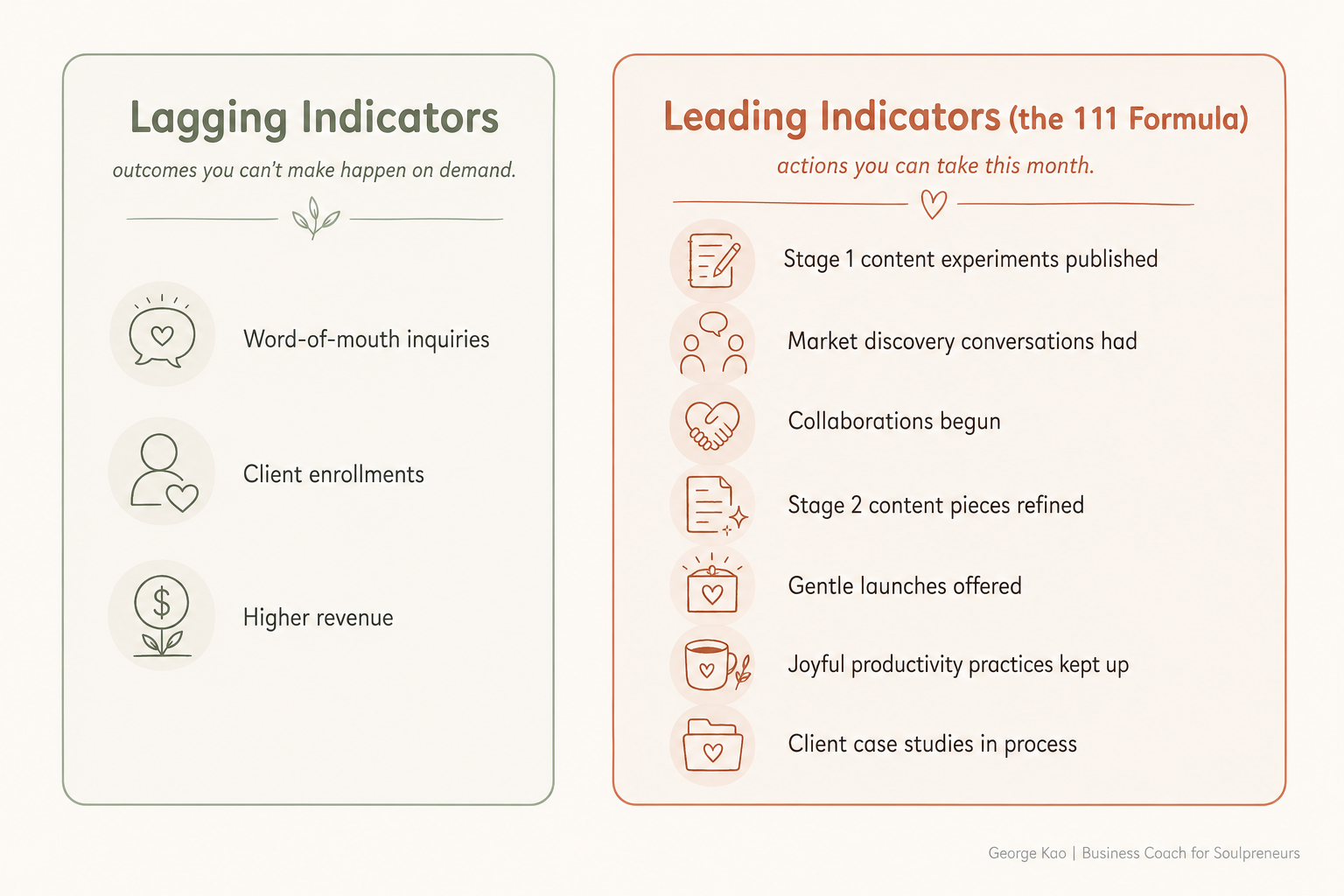
Leading versus lagging indicators. Lagging indicators are the outcomes you can’t make happen on demand — word-of-mouth inquiries, client enrollments, higher revenue. They’re real, and they matter, but they’re slow and largely outside your direct control. Leading indicators are the actions you can take this month, the ones that compound into the lagging ones over time.
For a soulpreneur, the clearest leading indicators come from the 111 Formula — the practices you’re putting in this season:
- Stage 1 content experiments published
- Market discovery conversations had
- Collaborations begun (interviews, co-posts, guest content)
- Stage 2 content pieces refined and redistributed
- Gentle launches offered
- Joyful productivity practices kept up
- Client case studies in process
The rule I hold: if the leading indicators are alive (you’re moving steadily through the 111), even while the lagging ones stay slow, keep going — the actions compound long before the outcomes show. If both have been flat for six months and you can’t clearly point to what you’ve learned, it’s time to pivot or pause.
From “will this work?” to a better question
This is the reframe I most hope to leave you with:
The philosopher James Carse drew a line between finite and infinite games. A finite game is played to be won. It has winners, losers, an endpoint. An infinite game is played for the sake of continuing the play.
A lot of family pressure, I think, comes from evaluating the soulpreneur path as a finite game: are you winning yet? And the practitioner is usually living inside an infinite one: can I make more impact? can I keep deepening this service? can I keep playing? They’re simply different perspectives, and much of the pain in that dinner-table conversation is two people not noticing that they’re asking different things.
This isn’t avoidance, though. The infinite-game player still has to ask which finite metrics keep the infinite game alive: health, money, capacity. Those matter precisely because you want to keep playing.
But the reframe does change the central question. It’s no longer will this work?, which was never forecastable anyway. The question becomes: can I afford to keep playing, and is the playing itself the life I want? If the answer is yes, optimism is simply the rational stance. If the answer is no, it’s time to redesign, rest, or release.
Why the longest view makes this stronger
There’s one more layer, and for soulpreneurs I think it’s the deepest one.
When you stretch the time horizon out far enough, to the spiritual, the intergenerational, the soul’s longer arc, grounded optimism stops looking delusional at all. It begins to look like the only sane response to a life that holds far more than a financial bottom line.
This isn’t a new idea. The contemplative traditions have circled it for a long time. The Sanskrit word shraddha, often translated as “faith,” is closer to “placing the heart upon.” It describes a baseline orientation of trust, the posture that lets you keep your heart in the work. The Sufi notion of tawakkul is trust in God while acting, an active surrender and never a passive one. And some Indigenous governance traditions weigh decisions across seven generations… which can show us how impoverished our ninety-day timelines really are.
The practitioner who lives by the quarter is exhausted by the quarter. The one who lives by the lifetime can hold a flat season, because in that longer story, it’s just a season.

A closing blessing
So, yes: you’re being a little “delulu.” And I hope you can feel, by now, why I don’t think that’s the same thing as denial. It may simply be the only stance available to someone whose work can be discovered only by doing it.
And the people who love you aren’t foolish either. They’re looking at your capacity and sustainability.
Survivorship bias is real. Sometimes the most loving thing you can do for your own life is to change course. That choice, when it’s the right one, is your discernment at work.
The point is not to keep going no matter what. Don’t let finite-game reasoning alone stop you, because that would have stopped everything that ever mattered.
If something here stirred for you, I’d love to read it in the comments, especially if you’re in the middle of that conversation right now. Allow yourself to be seen by other soulpreneurs who get it. 🙏🧡
May you know the difference between holding faith and merely holding on. May your optimism stay rooted in action and relationships. And may your work, in whatever form it grows into, keep serving the souls who need it!
Visit the comments section here (and feel free to add yours!)
