Follow Your Fascination, Then Align It with the Market

This is for “soulpreneurs” — aka solopreneurs who want their work to feel like play, who sense that “grind harder” isn’t sustainable, and who want to build from genuine curiosity instead.
A soulpreneur business lives at the intersection of what lights you up and what people already value enough to pay for.
This post focuses on the first half — what lights you up! — because without that, you might burn out before the business ever gets traction.
The Core Idea:
Find the thing that makes you naturally fascinated — the thing you keep returning to with devotion, aliveness, recurring curiosity — and then align it with what people already value.
However, I need to clarify something that often gets misread: following your fascination is not a permission slip to ignore whether anyone wants what you’re building…
Fascination without market awareness is a hobby. Of course, there’s nothing wrong with a beautiful hobby! But, as a soulpreneur, if you want a business that sustains you and reaches the people who need your work, then your own fascination alone isn’t enough.
The reverse is true too. Market awareness without fascination becomes a grind that can eventually break you… you end up serving something you don’t care about… an inauthentic business.
The traditional model says: find what the market wants, then force yourself to provide it. That can work — but it often leads to burnout for soulpreneurs.
Let’s get to financial sustainability, yes, but from a different starting point: find what you’re naturally fascinated by, then filter for the parts that meet a real market need. Start with what lights you up, then ask… where does this aliveness intersect with something people already want, already seek help for, already invest in?
If you read Your Income Comes from Their Spending, you know I take the market side seriously. Your income comes from what people already know to invest in. But this post is about the first part. Let’s first work on finding the fire.
What I Mean by “Fascination”
Actually, for some people, “obsession” might be a more resonant word. It carries the right intensity. For others — especially those recovering from burnout, or who are a bit tender in this season — “obsession” might feel too compulsive, the very energy they’re healing from…
So when I say “fascination,” I mean: Aliveness. Devotion. Sacred curiosity. A recurring pull towards something. The thing that always seems to energize you. The topic you return to again and again, without anyone asking you about it.
The thing you’d explore, even if no one paid you, even if no one saw it! It keeps showing up, insistently. Sometimes quietly, but it keeps showing up.
Fascination Outlasts Discipline.
Paul Graham wrote about the “Bus Ticket Theory of Genius.” Some people obsessively collect old bus tickets. Not for any practical reason — they just find them genuinely interesting. Graham noticed that this same quality — an almost irrational fascination with things that seem pointless to others — is what often drives real breakthroughs. Collectors of obscure knowledge, tinkerers following threads that few (or none!) around them are interested in… they end up discovering paths others miss entirely.
Graham’s core insight: genuine interest makes you work harder than discipline ever could! And it even selects for better problems.
Discipline says “keep going.” Fascination says “I can’t help but go to this place that almost no one else seems interested in.”
Stanley and Lehman arrived at a similar conclusion from a different direction. In Why Greatness Cannot Be Planned, they show (through research in AI and evolutionary systems) that ambitious and “clear” objectives can actually prevent you from reaching them. The stepping stones to any great achievement often look nothing like the final destination. You often can’t draw a straight line from here to there.
What works instead? They recommended following your interestingness. Pursuing the next curious, novel step — not necessarily because it maps onto a five-year business plan, but because it will open doors you couldn’t have predicted.
They call it the “treasure hunter” problem: you can’t navigate to a treasure no one’s ever seen. But you can follow interesting stepping stones… and many of those lead somewhere remarkable.
Research on intrinsic vs. extrinsic motivation supports this: intrinsic motivation leads to greater persistence, creativity, deeper learning, and lower burnout — especially in creative, relational, and knowledge work.
That’s exactly the work soulpreneurs do. You’re not running a factory! You’re doing nuanced, presence-based work that needs you genuinely engaged… not just clocked in.
Here’s what fascination-as-compass looks like in practice:
A breathwork facilitator who reads trauma physiology at night — not because a course told her to, but because she can’t stop. She follows researchers on social media. She brings new questions to every session. No one assigned this. It found her.
A spiritual mentor drawn to the rituals and thresholds of life transitions — birth, death, career endings, identity shifts. She collects anthropological accounts of rites of passage. She notices liminal spaces in her clients’ stories before they do. Not a niche she chose strategically. A thread she’s followed her whole life.
A coach who keeps returning to attachment theory long after certification ended. His shelves are full of books on the subject. He sees attachment dynamics everywhere — in clients’ lives, his own relationships, the patterns of teams he works with. The certification gave him a framework. The fascination predates it.
These aren’t distractions! They serve as important clues…
Three Reasons to Start with Fascination:
Pull instead of push.
If your spirit is tired — tired of pushing, tired of competition, tired of performing — the answer probably isn’t “more discipline.” You’ve already tried that.
What you need is a different kind of energy. Fascination provides pull rather than push. When you’re working on something that genuinely captivates you, you don’t have to manufacture motivation. The work draws you toward it.
That pull is renewable in a way willpower isn’t. For a soulpreneur with no team to carry them through the low-motivation days… renewable energy isn’t a luxury. It’s about survival.
Depth that can’t be forced.
The most original contributions rarely come from trying to outperform a competitor. They come from someone so absorbed in a question that they explore angles others would find impractical or strange.
When you’re grinding, you run out of energy for new angles. When you’re fascinated, the looking itself gives you energy.
The breathwork facilitator who reads trauma physiology for fun will eventually understand her clients’ nervous systems in ways someone just following a protocol never will. That depth becomes her edge — not because she planned an edge, but because she couldn’t stop exploring.
(This is Stanley and Lehman’s insight in action: her stepping stones didn’t look strategic at the time. They looked like wandering. But they led somewhere no planned curriculum could have taken her.)
Authentic differentiation.
We live in a world increasingly saturated with templated strategies and “optimized” everything.
In that world, your unique human fascination is your strongest differentiator. No algorithm can replicate your exact combination of interests, lived experience, and devotion. No competitor can fake the specificity that comes from genuine, sustained curiosity.
People sense the difference between someone captivated by what they’re sharing… and someone performing expertise for a market. That sense builds trust!
Two Modes — Grinding and Playing
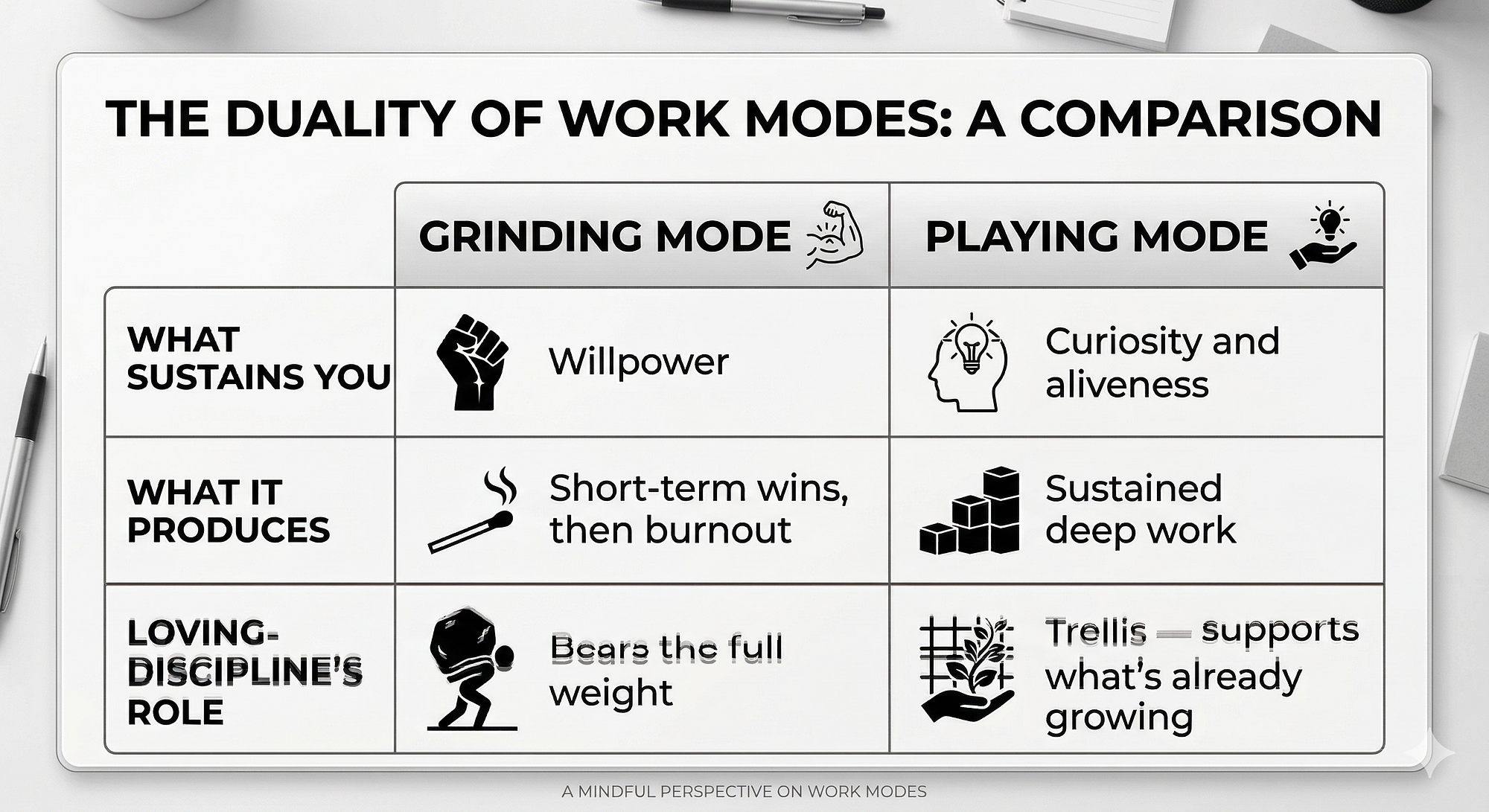
Most soulpreneurs have lived in both. They’re not permanent identities — just states you move through. But naming them helps, because the difference changes everything about whether your business survives long enough to compound towards success.
There’s a saying I keep coming back to:
“Find the thing that looks like work to others but feels like play to you.” — Naval Ravikant
An important nuance: “play” doesn’t mean easy. Following your fascination still involves unglamorous work sometimes — admin, difficult conversations, moments when the spark goes quiet yet you show up anyway. The difference is that a current of deep interest carries you through those stretches… instead of willpower alone.
And loving-discipline is not the villain. It can protect your curiosity. A weekly writing practice is loving-discipline. Protecting your mornings (or afternoons, or evenings) for deep work is loving-discipline. Saying no to projects that scatter your attention is loving-discipline. These are acts of devotion to your own aliveness.
The trouble starts when discipline replaces curiosity instead of serving it. When you’re grinding, discipline bears the full weight. When you’re playing, discipline is the trellis — it supports what’s already growing toward the light.
Loving-discipline in service of fascination. That’s where sustainable, extraordinary work comes from.
You’re not opting out of excellence. You’re choosing the version that feels like flow instead of friction… the one that lets you bring your full presence to the people you serve. You’re not retiring from work — just from toil.
Four Steps to Hunt, Protect, and Align Your Fascination:
Step 1 — Hunt for your “recurring pull” signal.
Start by noticing what already pulls you — no matter if it monetizes or anyone asks you about it.
Ask yourself: “What topic would I happily read books and watch documentaries about, or explore for months, even if no one ever saw it?”
This cuts through a lot of noise. It bypasses what you think you should be interested in, what your certification trained you in, what seems marketable. It points straight at the thing you can’t leave alone.
Then journal the edges and threads that keep showing up — especially the ones that feel a little strange, niche, or hard to explain. The fascinations that make you think “Is this too weird?”… those are often the strongest signals. The strangeness is a clue you’re following something authentic rather than borrowed.
(Stanley and Lehman would call these “stepping stones that don’t look like they lead anywhere.” They often do.)
Step 2 — Protect the aliveness, and gently test it…
Start micro-projects around your fascination. These aren’t big, polished, or strategic. Maybe a single essay. A recorded reflection. A short experiment with 3 people. The point is to engage actively, not just think about it!
Then start to ship tiny experiments publicly — notes, short videos, threads, whatever your natural medium is. Not to sell, but to invite feedback and serendipity. I call this Stage 1 content. (If not familiar with that, read the 3 Stages of Content Creation.)
When you share something you genuinely care about, you create conditions for resonance. Some people who find it will be fascinated too. Some will ask questions you hadn’t considered. Some will connect you to communities you didn’t know existed.
As responses (eventually) come in, notice: What do people ask for? What overlaps with things they’re already spending on (coaching, books, retreats, courses)? These are early hints of market alignment.
Something I’ve seen again and again: you don’t always have to hunt for the overlap between your fascination and the market. Often, when you make your fascination visible publicly… the overlap finds you.
Step 3 — Build gentle structure so fascination doesn’t scatter.
Fascination without structure can dissipate. You follow one thread for a week, get excited about another, abandon the first, start a third. Three months later — a dozen half-explored interests and nothing to show for any of them.
This is where loving-discipline (the trellis kind) earns its place.
Pick no more than 2 deep dives per quarter, plus a “curiosity queue” for lighter exploration. The deep dives get your real time — maybe 2 hours each morning, or evening, or whatever rhythm works for you. The curiosity queue captures the other sparks so they don’t distract you now but aren’t lost for later.
An optional public commitment — a newsletter, a webinar series, a tiny mastermind (free if needed) — can help add to the pull that helps keep you going. When someone’s expecting your next piece, or you’ve told a small group you’ll explore a topic together this month… you have a gentle reason to show up on the days when fascination dips.
Structure in service of curiosity. Not a cage around it.
Step 4 — Give yourself permission not to monetize every sacred interest.
Not every fascination needs to become a business. Some should stay personal, devotional, private — and that’s not a waste! If you try to monetize every sacred thread in your life, you risk draining some things that are part of your wholeness, your aliveness.
A useful filter: “Do I want a relationship with this topic that includes clients, expectations, and financial exchange — or do I want it to remain private?”
Some fascinations are meant to be your business. Some are meant to be a private sanctuary. Knowing the difference is part of the discernment this path asks of you…
What About Income?
I can hear some of you: “This sounds beautiful, but I need to pay rent.”
I want to honor that directly.
If you need income soon, pure curiosity-following may be a luxury you don’t have, yet. You might need to start with the market — begin with what people already want and invest in — and let your curiosity grow into it over time. No shame in that!
But here’s a reframe: even in a market-first approach, curiosity adds flavor. You can become genuinely fascinated by understanding your people — their pain, their language, their world. Empathy practiced deeply becomes its own form of fascination. You start listening to their struggles, and before you know it, you’re captivated — not by an abstract topic, but by the living reality of the people you serve.
For more about the income-prioritized path, read: Your Income Comes from Their Spending.
Your Turn:
Pause the strategizing for a moment…
Instead, write down 3–5 topics or activities where you lose track of time. The threads you may have been following for years… because you’ve been exploring your interestingness.
Don’t ask “is this marketable?” yet, or “does this make sense as a business?” Just allow yourself to write them down.
Then, look at the list and notice which ones give you energy just reading them back! Which ones make you think “I have so much more to explore here”?
The alignment with the market — that comes later, and it’s a skill you can learn. But the fascination itself? That can’t be manufactured. It can only be noticed… and protected.
I look forward to hearing what you discover 🙏🧡
Visit the comments section here (and feel free to add yours!)
