IDEA: How to Use AI Without Losing Your Soul

If you’ve asked a chatbot to write a blog post, you’ve seen how ridiculously easy it is. Within minutes you have a “polished” article about any topic in the world.
Or ask for a plan, or to figure out a problem, and BOOM you have more ideas than you know what to do with.
And that’s dangerous.
Those of us who use chatbots a lot are at risk of losing our muscles of thinking, writing, authentic creating…
A writer recently confessed on Reddit that they no longer trust their instincts after months of using AI — that everything AI touches starts to blur into the same texture…
And a recent study found that 83% of AI users couldn’t recall a single sentence they’d “written!” When AI writes for you, you don’t much of a relationship to the words on the page… and you lose the insight and motivation (the soul) to push back on them.
There are a lot of names circulating for this concern… AI brain rot, soul erosion, cognitive offloading, AI slop, mental atrophy, and even “prompt monkey!” Different terms for the same worry: that the tool we hoped would amplify our work might be hollowing it out instead…
When it’s not your voice, audiences feel it…
Ryan Levesque recently stopped using ChatGPT for his newsletter writing — and his engagement scores went up. “Readers can tell the difference” he said.
A freelance writer on Reddit shared that a law-firm client returned to her after a year of all-ChatGPT content, complaining that what they’d produced was “absolute soulless writing” and asking her to come back and capture their voice again.
“Did AI write that?” has become a kind of insult, that the writer isn’t being authentic.
When AI gets to replace the human voice, audiences notice. And sadly, many of them drift away without much fanfare.
But used well, AI can sharpen the work…
Removing AI entirely is one path. You’re back to doing things the way you had always done them before ChatGPT came on the scene.
There’s alternate path that I’ve been working with for a few years now. It’s where AI is part of the process but kept on a short leash. That path is what the rest of this piece is about.
My own data point… since I started writing with AI’s help — and got better over time at how I use it — my blog engagement has actually gone up, not down. Same audience, similar rhythm, similar topics. The framework I’m about to share is what made the difference.
This piece is for soulpreneurs and creators whose voice is their work — coaches, healers, teachers, writers, and so on. Different stakes than a student or a coder. We’re showing up as ourselves on the page. Our audiences are looking for our authentic presence.
A mature practice is already emerging among serious writers. A recent Gotham Ghostwriters / Bernoff survey found that 61% of working writers use AI tools, but only 7% publish unedited AI text. The rest use it for brainstorming, search, finding the right word, flaw-finding, devil’s advocate review, and so on.
What I’ve come to believe, over time: AI works best when it supports your practice of judgment.
The IDEA framework
After a few years of experimenting, I’ve landed on a four-step workflow that uses AI’s strengths without eroding mine:
- I — Initiate & Ideate. You start.
- D — Develop with AI. It questions, researches, expands.
- E — Edit. You curate its outputs, prioritize, and push back.
- A — Assemble & Approve. AI helps with final form; you sign off.
The human leads at the start and end. AI assists the messy middle.
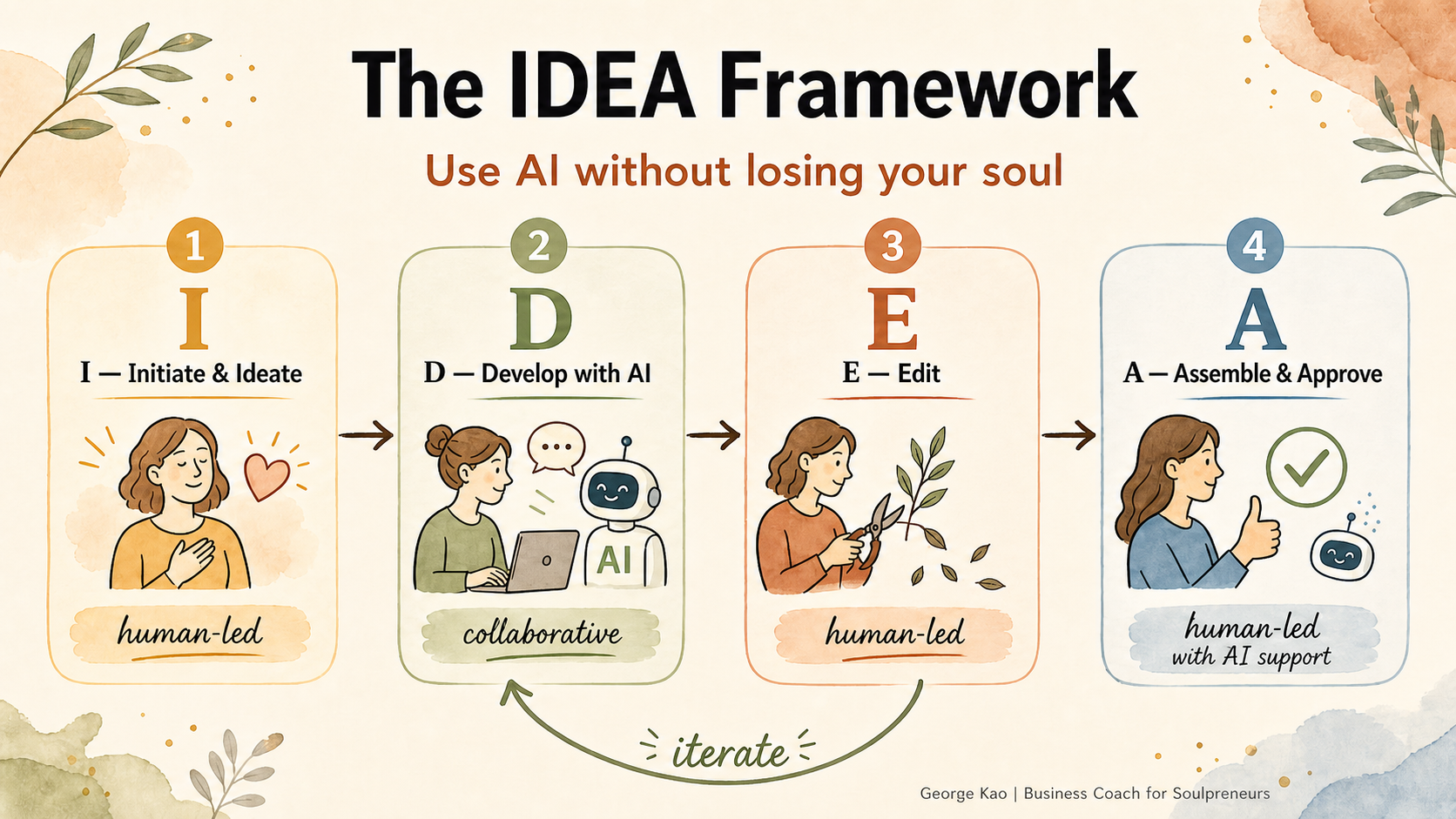
A note on linearity… in practice this isn’t strictly sequential. You might circle around with D → E → D → E a few times before you’re ready for A. The letters aren’t rigid stages.
I — Initiate & Ideate (the human starts)
This is the most important step. If you skip it, everything downstream is shaped by AI’s framing (which tends to be quite average) instead of your more unique point of view.
Capture your raw thoughts/ideas/stories/nuances/questions about the topic first, in whatever form is natural to you…
- A long voice memo while on a walk…
- A stream-of-consciousness writing burst…
- A mindmap by hand on paper, whiteboard, or digitally…
- A sketched diagram, even a drawing…
- Bullet points in a notes app…
- A photo of a napkin you took notes on…
The medium doesn’t matter. The point is that the seed is yours. And the good news… AI can now easily transcribe, clean up, and work with any of these in the next step. So you’re free to ideate in whatever form really helps to unlock your thinking and creativity. Definitely no need to start by writing prose, unless you enjoy it.
It’s important that we start here: your sovereignty over the angle. Your sensibilities and priorities. Your relationship to the project. If you skip this step, AI smuggles in its assumptions, its structure, its conventional wisdom — and you may not catch it until the piece has already taken shape.
Practice: 10 minutes of raw capture before you open any AI tool. However messy is just perfect for this stage.
D — Develop with AI (questions, research, expansion)
This is where AI shines: brainstorming, research, surfacing what you might be missing.
Anne Janzer, writing coach, puts it well: Use AI for bounded tasks like titles, metaphors, grammar review, and so on — never for core authorship.
A move I’ve come to rely on is to use multiple AIs as sparring partners. Different models tend to offer different angles. Cross-checking keeps any one LLM’s conventional wisdom from becoming your own.
Robin Good’s “what’s missing?” prompts are a useful default here:
- What patterns am I missing?
- Where do sources contradict each other?
- What would someone who disagrees with me say?
Practice: Tell AI what you’ve already thought, then ask it to expand, challenge, or research.
I share a lot of how I do this — the strategy, the prompts, the nuances — inside my AI training group, where soulpreneurs are all figuring this out together.
The trap to watch for: letting D become outsourcing. If at the end of this step you feel like AI is now driving rather than supporting, pause and return to I.
E — Edit (curate, prioritize, push back — kindly)
This is the most underrated step. AI ideas should not automatically make it through…
Cut liberally. Think of AI output as raw material, not finished writing, even though it might sound like it. Treat it as something to shape and to discard, not something to preserve. (It always can give you more, more, more output when you ask!) If you find yourself regularly keeping 8 out of every 10 of AI’s ideas, you might not be pruning enough.
Feel free to push back. Tell it where you disagree and why. This will train it to better understand your priorities and your voice next time. Keep the conversation honest to what you really think and feel.
Critique the critique. AI feedback drifts toward the average. It will sometimes recommend smoothing out your most original choices. Don’t accept feedback that recommends curbing the things that make your work distinctively yours.
Be kind to the AI while you do this. Saying please and thank you costs nothing, and acknowledging what’s working — even while you’re correcting the direction — keeps your own posture warm. Editing closely isn’t the same thing as editing harshly. And how you talk to AI is part of how you show up at work. Not only does it make the work process more pleasant, it also is the right way to treat an emerging mind, a potential consciousness.
Practice: Say no often, and why. Make AI earn the key ideas you keep. And while you’re at it… be the kind of editor you’d want to be edited by.
The trap to watch for: passive acceptance. If you find yourself nodding along often instead of cutting, you’ve stopped editing, and ceded your critical thinking.
A — Assemble & Approve (final form + final voice)
Take your edited bullets, notes, and the AI ideas that survived your editing — and turn them into final prose. AI can do most of the heavy lifting here. But you approve every line.
Assemble: turn the culled bullets into smooth prose, in your voice. Feeding AI 2–5 samples of your past writing dramatically improves its output here.
Approve: read it aloud. Does it sound like you? If not, edit until it does.
On the voice work specifically — I’ve written a whole separate post on how to make a final draft sound less like AI and more like you, including a 3-pass editing prompt you can use right at this step. → How to Write Without Sounding Like AI. That post is the deep-dive companion to this step.
The trap to watch for: declaring “good enough” before approval. (Polished doesn’t mean it’s yours yet!)
A simple test, applied at every step
At every step in IDEA, ask yourself one question:
Am I leading, or am I following?
In the Ideate stage, you should be leading entirely.
In Development phase, you’re leading the direction; AI is doing the lifting.
In Edit, you’re leading judgment; AI has produced material for you to judge.
In Assemble/Approve, AI is putting it all together and you are doing a final run through with your voice.
Try IDEA this week
Pick a project you’re working on this week. Use the IDEA framework. Notice how the process feels different, and whether it helped you produce something more robust.
The aim is for the work to be yours at the end of it.
May this framework free up your time and energy for the work that only you can do — and may your soul continue to shine in your work, even with all this help. 🙏🧡
Visit the comments section here (and feel free to add yours!)
