A Simple Plan for Financial Freedom

The definition of financial freedom I use is a modest one — enough passive income to cover a simple, comfortable lifestyle. And I believe it’s within reach for many soulpreneurs… sooner than they think.
For me, keeping my costs low has taken a lot of pressure off. I get to make bolder, more values-led decisions, and “work” feels more like play and service now.
This post shares my own beliefs after some years of research and investing. It is not necessarily a recommendation for you. You should do your own research before making your own investment decisions. What I outline below carries real risk.
However, my hope is that by reading this, you’ll gain a clearer sense of how you might reach your own financial freedom… and how much closer it might be than you think!
What makes freedom much easier to reach…
Financial-freedom guidance often says: Make a lot more money! Invest better!
But the other side of the equation makes reaching freedom easier: reduce your living costs. The least painful way (for day-to-day decisions) is to move to a low-cost region so that all the major purchases are naturally cheaper.
Every $1,000 a month you don’t need is something like $200,000 you never have to accumulate.
If your life costs $6,000/month, you need something like $1.2 million to be set for life. If your life costs $2,500/month (as mine does), you need something closer to $500,000… or if you’re willing to invest in something riskier (see section one below) you might only need to invest $107k and then wait 5 years.
Financial freedom is most easily reached by moving to a lower-cost region.
My wife and I live happily on $2,500/mo, without having to penny-pinch when we buy everyday goods & services, by living in Mexico where most purchases are cheaper compared to the USA.
No investment strategy moves the needle as much as simply moving to somewhere lower-cost.
To be safe, every figure in this post already assumes these guardrails:
-
3% inflation. So that you can maintain your lifestyle over time, instead of having to spend less and less as things get more and more expensive.
-
25% tax on whatever you withdraw. This may be higher or lower for you, depending on your tax region and type of investment account.
-
10% extra on top, as a buffer and to keep adding to a rainy day fund.
And one more assumption is baked in — today’s prices. Every figure below uses the price on the day I last updated this post — 5 October 2026. (When I first wrote it, on 12 September 2026, bitcoin was about $77,400, and the 5-year amount below was $98,000. Now bitcoin is about $85,600, and that amount is $107,000.) Prices move. Near the end of the post I give you a prompt so your AI can redo every number for your day, and your monthly expenses.
In other words, when I say “$2,500/month,” I mean $2,500 of actual spending money, after the tax bill, with a little slack, holding its value against inflation.
If your own tax rate is lower, or you need less passive income, every number below gets smaller and easier.
What $2,500/month actually buys:
We currently pay 17,000 pesos — about $1,000 USD / month — for a spacious 2-bedroom house with a large yard and a little outdoor office, in actually a relatively expensive part of Mexico. (There are other expats who spend as little as $200 USD / month for a small but comfortable home in less expensive parts of Mexico.)
A few other places worth researching (try Numbeo although I think “homes” there don’t assume a yard) with rough all-in monthly figures for a couple:
-
Mexico — $2,000–$3,000.
-
Chiang Mai, Thailand — $1,500 on the modest end, around $3,000 comfortable.
-
Tbilisi, Georgia — about $2,000 and a US citizen can stay a year without a visa.
-
Asunción, Paraguay — about $1800.
Treat any single number you find online as give-or-take 30% depending on your needs. And remember, the number don’t stay absolute forever: inflation keeps raising the cost little by little over time.
One thing you can’t escape:
Low cost of living and low taxes are two different questions.
Some countries only tax income earned inside their borders. Your dividends and capital gains from abroad, sit outside their system. Paraguay, Panama, Costa Rica and Georgia all work in this generous way. Uruguay gives new residents around eleven years of the same treatment.
Other countries — including some of the famously cheap ones — will tax your worldwide investment income once you become a resident there. And if your US tax bill is already near zero, the foreign tax credit has nothing to cancel out. You just pay the other country.
Research this for your own case before you move, not after. It gets expensive to find out late!
Getting to $2,500/month passive income:
Three approaches. I’ll go through them in the order of ease of getting there…
My favorite approach for most people is the 2nd one, so please keep reading or just scroll down there, if you want to skip the “easiest” (but also considered by the mainstream to be “highest risk”) method: bitcoin.
These three are what this post is about, though my own portfolio is more diversified than just these. I’ve written separately about where I invest my money and how I spread it around. But here are 3 simple approaches that work too:
1. Bitcoin, and the Power Law
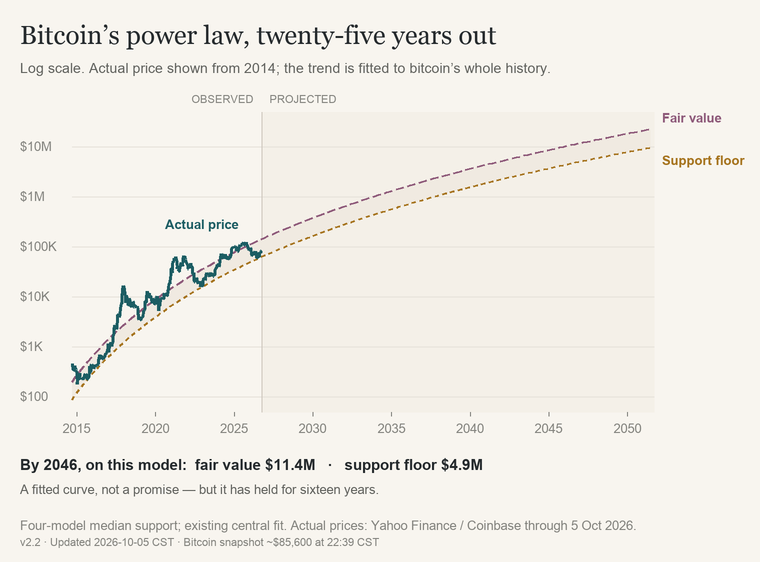
Bitcoin has tracked a “power law” since 2010 — a mathematical trajectory that fits sixteen years of data and has, so far, described its long-term returns accurately.
There is one line that I particularly care about:
The support floor — the conservative measure, to be safe. As of today, it sits around $63,000. Since 2012, Bitcoin’s price has held above that floor more than 99% of the time.
Bitcoin today (5 October 2026) is around $85,600. That’s about 35% above the support floor, and about 41% below the model’s fair-value line. So the price currently is what is called “below trend” and “above support” — which can suggest a good time to invest.
Here’s what that means you’d need to put in today — at today’s price of about $85,600 — in order to draw $2,500/month for life (in today’s dollars, adjusted for inflation)—
-
If you want passive income of $2,500/mo (today’s dollars) for life, starting 5 years from now — you’ll need to put in about $107,000 today into Bitcoin. Just one single investment, and the income keeps coming for 200 years.
-
If instead you don’t need the $2,500/mo until 10 years from now? — you’ll need to invest about $50,500 today.
-
In 15 years — about $28,500.
-
In 20 years — about $18,000. Again, just one investment and you’re set! But it takes a lot of waiting.
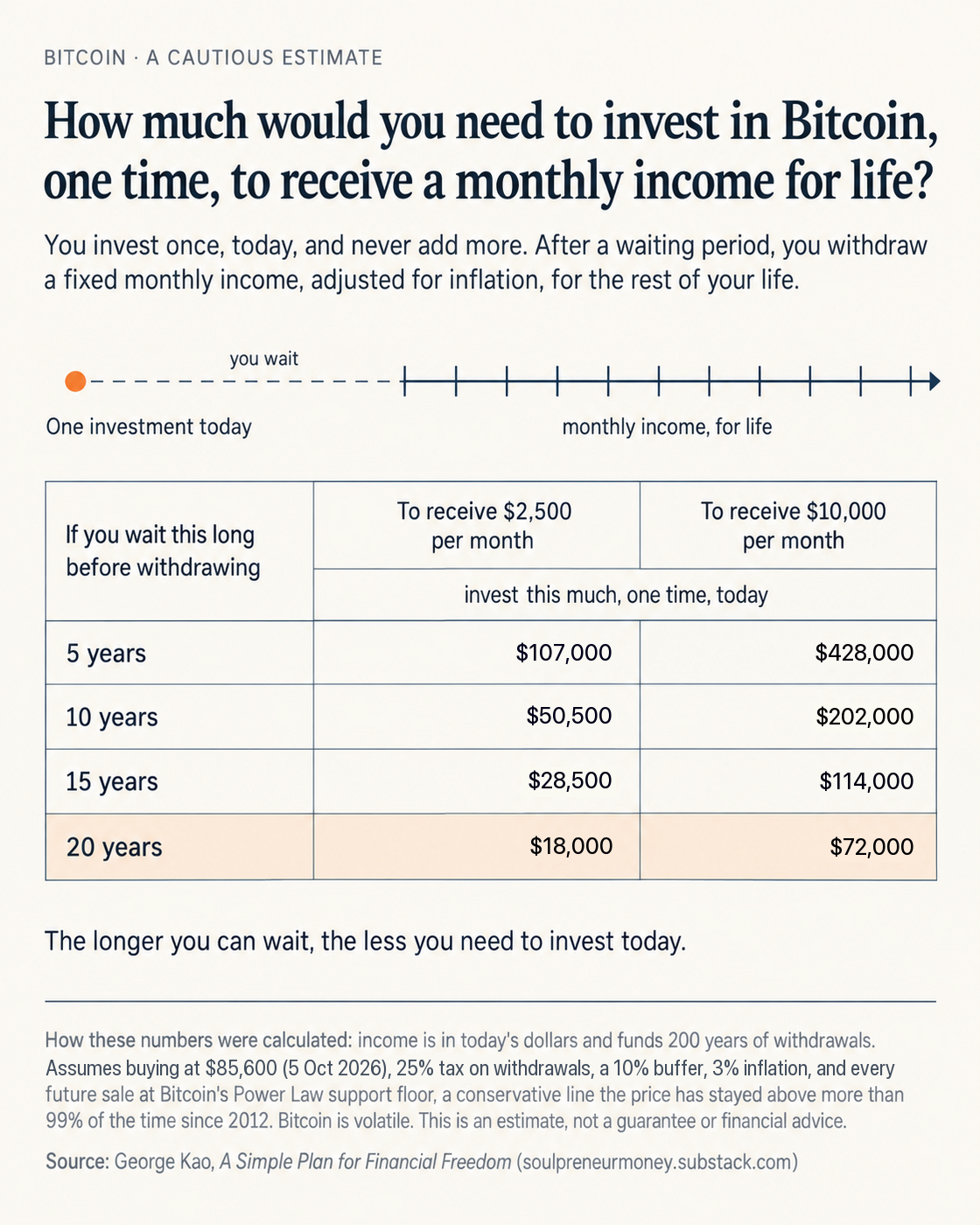
Those investment numbers already consider the 25% tax, the 10% buffer, and 3% inflation. If bitcoin is higher when you read this, the amounts you must invest go up in proportion; but if it’s lower, the amount comes down. Further down in this article I’ve given you a prompt you can put into your AI to determine the number you need on the day you invest.
Again — these aren’t 40-year retirement numbers. They’re built to fund 200 years of withdrawals, and built the cautious way: every coin is valued at the support floor on the day you sell it, even though bitcoin has traded above that floor more than 99% of the time. On the Power Law model the floor keeps growing faster than 3% inflation until around the year 2200, and that’s what makes two centuries affordable. Not literally forever — but far longer than anyone reading this will need.
Also — timing of when you invest matters a lot here, because Bitcoin moves in cycles. What part of the cycle you enter, can change your outcome for years.
Right now it still looks like a good time to invest. I wish I had started my bitcoin journey now (at about $85,600 in price) … instead of when I went all in last year, at a high point of the cycle, when it was $111,000!
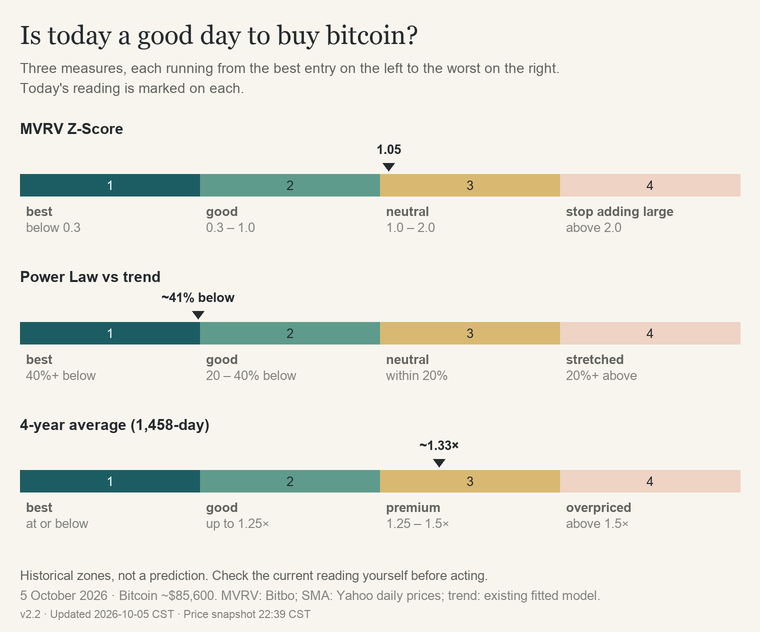
Is today a good day to buy?
I really wish someone had told me the following. I didn’t know these three measures existed — so I bought most of my bitcoin when the MVRV Z-Score was around 2.5, which is deep into the zone where it would’ve been wise to stop investing.
It will most likely still work out for me, because I’m planning to hold for decades without selling. But I paid far more than I needed to, and I put myself through a lot of unnecessary anxiety…
You get to learn from my mistake.
These three measures tell you roughly where you are in Bitcoin’s up-and-down cycles:
1. MVRV Z-Score — how far today’s price sits above what the average bitcoin last moved at, scaled by its price history. Below 0.3 has been the best time to invest; 0.3–1.0 is good; above 2.0 is where it’s wise to stop adding large amounts. (Which is exactly where I was buying! I didn’t know. Now you do.)
2. Power Law — how far below the long-term trend line the price is sitting. More than 40% below trend is best; 20–40% below is still good; within 20% either side of trend is neutral; more than 20% above trend is wise to wait and not invest.
3. The 4-year average — the 1,458-day moving average (close to what traders call the 200-week average). At or below is best; up to 25% above is still OK; more than 50% above means you’re overpaying.
As I update this post — 5 October 2026, with bitcoin around $85,600 — the signals are mixed: still roughly 41% below the Power Law trend, but the MVRV Z-Score has risen to about 1.05 (neutral) and the price is about 33% above the four-year average.
When I first wrote this post, on 12 September 2026, the picture was better: all three were in the green (MVRV Z-Score 0.77, about 45% below the Power Law trend, and 22% above the four-year average). These numbers move, which is why it’s worth using the prompt below the chart.
But you’re probably reading this on another day. So don’t take my snapshot — go and get your own. Paste this into whichever AI you use:
Today is [DATE]. For Bitcoin, please look up and report: (1) the current MVRV Z-Score, (2) how far the price sits above or below its long-term Power Law trend line, as a percentage, and (3) the current price as a multiple of its 4-year (1,458-day) simple moving average. Use current values from the source sites, not search snippets, and tell me if any number is unavailable rather than guessing. Place each one in these bands — MVRV Z-Score: best below 0.3, good 0.3–1.0, neutral 1.0–2.0, don’t add large above 2.0. Power Law: best 40% or more below trend, good 20–40% below, neutral within 20% either side of trend, stretched more than 20% above. 4-year average: best at or below it, good up to 1.25×, premium 1.25–1.5×, overpriced above 1.5×. Give me the source and the date for each number. These are my chosen screening bands, not proven rules, so if the signals conflict, explain the conflict. Then tell me directly: based on this theory, is today a good day to be adding, an average day, or a day to wait? Thank you for your help.
Let the AI’s answer be an educated estimate of a good entry point, based on historical data… but of course, no one can guarantee perfect, or even good timing, for any investment. You still need to be the one who makes the decision you can live with.
If you’re new to all this, casebitcoin.com/newbie might be useful too.
How to buy bitcoin:
The easiest route, if you already have an investment account, is to buy IBIT — the iShares Bitcoin Trust. It’s the largest bitcoin ETF in the world. It holds bitcoin itself, and IBIT’s price follows bitcoin’s almost exactly. You buy it like any stock, in a retirement account or a regular brokerage account, and your return tracks bitcoin’s, minus a 0.25% fee (which is nothing compared to the return you’ll receive over years).
If you’d rather own actual bitcoin, ask whether your broker offers spot bitcoin. For US customers, Fidelity offers it and Schwab is rolling it out. Otherwise, Coinbase is one of the most widely used places to buy bitcoin, available in most countries.
I prefer to own bitcoin only via IBIT. I don’t self-custody. It’s also a safer this way in my opinion.
Whichever route you choose… buy, then leave the bitcoin alone!
What decides whether this works for you is whether you can HODL.
Bitcoin does not go up in a straight line. Since 2017 it has had big crashes — 83% one time, 77% another time, and 53% more recently— each crash felt permanent at the time, and it took two to three years to recover and make a new all-time high.
So if you put in $10,000, and eighteen months later you’re staring at $3,000, that is not a malfunction! That is the asset doing the thing it has always done. Just hold onto it. It’ll reach another all-time high within 5 years.
And when someone tells you that bitcoin is dead — a caring friend or family member will, who doesn’t understand bitcoin — take a look at bitcoindeaths.com. It has logged 478 public obituaries for bitcoin since 2010, the first one written when the price was 11 cents. The most recent came in August 2026, at $77,000.
One chart has been very reassuring to me through the short-term swings: bitbo’s Cycle Repeat chart. It takes the last four years of bitcoin’s price movements and simply replays them forward from today’s price.
If the last four years repeated exactly from today’s $85,600, bitcoin would first drop to around $70,000 this coming November… spend most of 2027 near $120,000… and reach the next peak, somewhere around half a million dollars, in late 2029. Then fall hard again, as it always has.
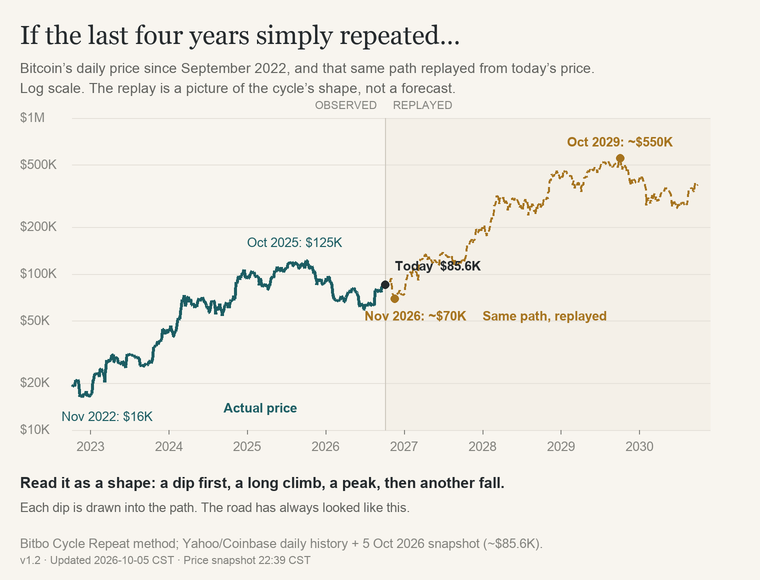
Nobody knows whether history will repeat.
Charts like the above are always estimates.
Reality could surprise us.
Plenty of people have tried to time their investment, and have been tricked again by Bitcoin’s real trajectory, which nobody has been able to perfectly predict. In other words, they tried to wait until the supposed-low, and it never came. Or they sold at the supposed high, but it only kept going up.
Still, I find the picture calming, because it shows that the dips are part of the journey.
Here’s what I’ve come to believe — the people who lose money in bitcoin are almost never the ones who bought at a bad price. They’re the ones who sold at a bad price — usually near a bottom, usually because they needed the cash, or because they simply couldn’t keep watching.
So, gently: don’t buy Bitcoin with money you might need within five years. Five years is roughly one full cycle. Go in expecting to watch it halve at some point… and expecting to do nothing at all in response.
If you can’t picture yourself sitting calmly through that, then this isn’t the right vehicle for you — and that’s a perfectly reasonable conclusion to reach. The other two approaches below don’t ask that of you.
The returns from each cycle low have been shrinking — roughly 118×, then 21×, then 8×. That’s worth understanding rather than fearing, because it isn’t the model cracking. It’s the model working exactly as it says it will. A power law predicts that percentage growth slows as bitcoin ages: the curve above grows about 37% this coming year, easing toward roughly 16% a year two decades out. Slower each cycle… but still well ahead of what traditional assets offer!
Important: Please do your own research, and see what conclusions you come to, before you invest in anything, including bitcoin.
2. STRC and SATA — the income engine — my recommended method for most people.
This is the approach I’m most enthusiastic about for monthly passive income… so please read the disclaimer (later in this section) before taking any action.
STRC is a preferred stock issued by Strategy Inc.
SATA is a similar security from Strive.
Both stocks are engineered to stay right around $100 USD per share.
STRC currently pays 12% a year in dividends, and they pay out twice per month.
SATA pays 13% — and now distributes daily.
To diversify, I hold both. Together they pay about 1% passive income each month (12-13% per year, paid out at least twice-monthly.)
This means $300,000 split between them produces about $3,000 a month, before tax.
However, after 25% tax, that $3k becomes about $2,250. And if you want the income to still be worth $2,250 ten years from now, you need to reinvest about 3% of your principal each year — which leaves roughly $1,500 a month you can spend, permanently, without ever touching the principal.
So there are two different questions here, with two different answers:
-
“I want $2,500/month now, after tax, and I accept that it buys a little less each year.” — about $367,000.
-
“I want $2,500/month that holds its value for decades, plus the 10% buffer.” — about $550,000.
I think of these a little like a long-term CD — you park money, it pays you, you keep the principal. However, please note:
There’s no FDIC insurance on these stocks. On the other hand, a bank CD in the USA is typically insured to $250,000 and has a maturity date on which you’re contractually owed your money back. These stocks have neither.
What there is instead is a track record of both companies actively defending that $100 share price.
For example, recently, Strategy established a repurchase program for its preferred securities and has since doubled it to $2 billion. In one week of early September 2026 alone, they bought back about $176 million of STRC (roughly 1.8 million shares). They’re also sitting on a $4.9 billion USD reserve to continue paying dividends. And, they hold 848,000 bitcoin which, at today’s price, is worth about $72.6 Billion USD — on paper, roughly 67 years’ worth of STRC dividends they can pay.
SATA is similar in their commitment to hold their share price at about $100 USD, and they hold an 18-month dividend reserve.
Why can these stocks pay such a high dividend? Because both companies are built around bitcoin, and they believe bitcoin compounds a lot faster over the long run than the ~12% they’re paying you. So it’s a good deal for them. We can profit from their conviction :)
Disclaimer:
This is my position, and it is notably risky. Neither security is rated. Both dividend rates are reset by each company month to month, so they can go down as well as up, although neither has lowered its rate so far. (STRC’s terms do limit how fast it can be cut — by about 0.25% per month, and never below the short-term US rate — and unpaid dividends have to be caught up before any cut.) The share-price-defense policies I quoted above are, in the companies’ own words, “current policies and recommendations, not contractual guarantees, and can change without notice.” And both stocks are, underneath, a bet on bitcoin. I’ve studied these companies and I have strong conviction in them. You should study them and reach your own conclusions before investing anything.
3. VT — the boring and reliable one :)
VT is Vanguard’s all-world-stocks ETF. One fund, holding thousands of companies across the world. You buy it, you hold it, and there’s nothing else to decide.
Global stocks have returned about 5.2% a year above inflation from 1900 to 2024.
At a 4% withdrawal rate — and including the tax and the buffer — $2,500/month means $1.1 million. For $3,000/month, $1.32 million. (These don’t move when you change the inflation assumption, because both the 4% and the 5% are after inflation already.)
If you’re building toward that $1.1 million at 5% after-inflation returns, here’s what you’d invest today: about $862,000 if you need it in 5 years, $675,000 in 10, $529,000 in 15, $415,000 in 20, $325,000 in 25.
Those are much bigger numbers than the bitcoin scenario. VT asks much more of you up front, and almost nothing of you in conviction — because with that one fund, you’re betting on the most diversified basket possible.
However, selling shares during a bad year leaves fewer shares to recover, which is why the 4% withdrawal figure sits below the 5% return.
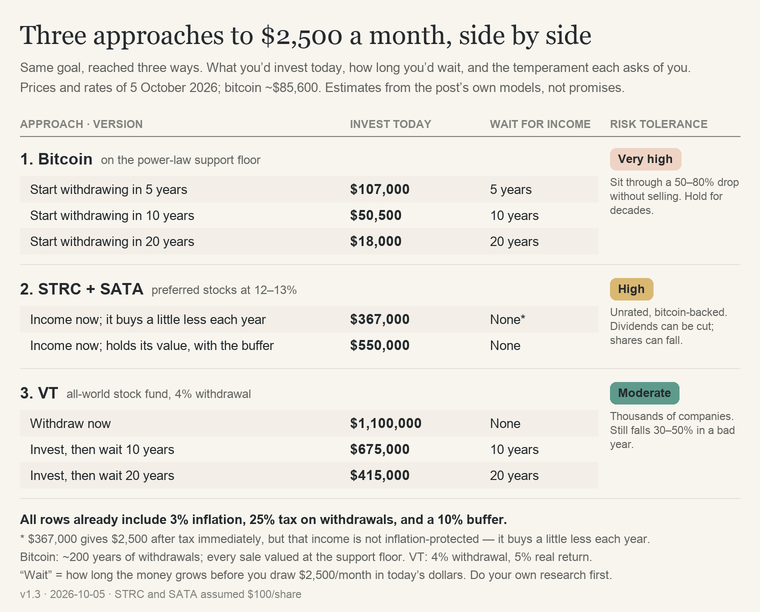
The three approaches, side by side:
Same goal — $2,500 a month in today’s dollars, for life — reached three different ways. The chart below puts them next to each other: what you’d invest today, how long you’d wait, and the temperament each one asks of you.
Make these numbers yours:
Every figure above depends on the prices and dividend rates of one particular day — 5 October 2026: bitcoin at about $85,600, STRC paying 12%, SATA paying 13%. By the time you read this, all of them may have moved. And maybe your monthly expenses is different from my $2,500/mo.
So don’t trust my snapshot. Have your AI redo the math for your day and your life… paste this into whichever AI you use:
Today is [DATE]. I want to know how much I would need to invest today to receive $[AMOUNT] per month of passive income, in today’s purchasing power, using the assumptions from George Kao’s post “A Simple Plan for Financial Freedom”: 3% annual inflation, 25% tax on everything I withdraw or receive, and a 10% buffer on top of my spending. Please calculate three scenarios and show your work. (1) Bitcoin: look up today’s bitcoin price, and the Power Law support-floor curve, for example it may be published at https://bitcoinpower.law Please find the formula for the whole curve, not just today’s value, so you can project it year by year. Assume I buy at today’s actual price, and that every future sale happens at that support floor. Tell me how much I would need to invest today if I start withdrawing in 5, 10, 15 and 20 years, funding at minimum 200 years of inflation-adjusted annual withdrawals from each start date, and show the formula you used. (2) STRC and SATA preferred stocks: look up their current annual dividend rates, and assume a 50/50 split bought at $100 per share, even if today’s share price is lower. Tell me how much I would need for that income starting now, and how much if I also reinvest 3% of the principal each year, after tax, so the income keeps its purchasing power. (3) VT, the Vanguard Total World Stock ETF: using a 4% withdrawal rate, tell me the total I would need, and how much to invest today to reach it in 5, 10, 15, 20 and 25 years at a 5% real (after-inflation) return. Add six months of my spending as a separate cash reserve. Give me the date and source of every price and rate you used, say which numbers you could not find rather than estimating them, and remind me that none of this is guaranteed. Thank you for your help on this important project.
What comes back is an estimate built on a model, and no one can promise you the future. But it will be your estimate, for today and your life.
But what if you’re starting with $10,000, or less?
Most people reading this aren’t sitting on half a million dollars.
The good news is that the lever here is time and consistency, far more than the size of your starting pile. On the same conservative support-floor path I used above (these are balances in future dollars, before any tax on selling)—
-
$100/month into bitcoin for 10 years — equals eventually investing $12,000 total, and end up with roughly $52,000 after 10 years.
-
$500/month for 10 years — you’d put in $60,000, and end up with roughly $261,000.
-
A single $10,000 today, left alone for 10 years — roughly $97,000.
That last one is the number that surprised me. And notice what it implies: the earliest dollars do most of the work, because they ride the whole curve. Ten years of $100/month buys you barely more bitcoin than five years of it would — the later contributions are buying at much higher prices. So — starting early, as soon as possible, does more for you than adding more over time.
Then, once you have a meaningful pile, you can move it into the income engine. That $500/month habit, after ten years, would throw off somewhere around $700–$1,000 a month in today’s purchasing power, depending on the tax you pay when you switch — while leaving the principal intact.
None of this is a reason to stop earning, though. Keep building your business. Keep serving people. This is simply what you do with the surplus, in the background, while the real work of your life carries on.
The steps:
1. Free up the money to invest. For me this meant selling our home. For you, it might mean redirecting retirement savings toward one of the above approaches.
Be careful with taxes and penalties. Changing what you hold inside a retirement account may be tax free. In the USA, withdrawing money before 59½ can cost you income tax plus a 10% penalty, which can eat a year of your gains!
2. Move to a lower-cost region. Consider only renting, not buying. This allows you freedom to explore, and not have to deal with local laws for property ownership and having to fix broken things. We are planning on renting long-term, maybe never buying another home.
3. Keep six months of expenses completely separate. Not invested — in cash, just in case. You don’t want to have to sell your bitcoin or stocks in an emergency.
You may see other advice about keeping 24-months of emergency expenses. Most Americans don’t even have 1 month saved. Therefore, six months is what I’d aim for.
4. Build inflation into your math from the start. At 3% a year, $2,500/month today becomes about $4,515/month in twenty years. This is why every scenario above includes something left over to reinvest, and why your “enough” number has to keep rising as your expenses do.
5. Don’t forget about taxes. This requires your own research. Where are you legally domiciled? Which countries and states do you need to pay taxes to? When you withdraw from your investments, how much in taxes do you need to pay? For example, while we live mostly in Mexico, we have a US address in Nevada — no state taxes — but we have to attend to both US and Mexico taxes for our work income and investments.
What I’d say to my past self:
I spent years believing the answer was to earn more.
My approach is mostly about needing less… and then being patient with a few simple investments for a long time.
The Middle Way I’ve written about? Turns out it applies to money too — not hustling, not waiting to be ready, just steadily doing the reasonable thing and letting time do the rest.
I’m telling you this because it’s what my wife and I chose, and, because I wish someone had explained all this to me years ago.
But it is not advice for you. Your situation, your risk tolerance, your family, your health, your country — all may be different from mine. Take this simply as one more input for your own research. Then make your own decisions. You are responsible for them.
I’d love to know…
Do any of the three approaches interest you to research further?
Do you have anything you’d love for me to write more about?
Or if you’ve reached financial freedom, what was your approach?
🙏🏼🧡
Visit the comments section here (and feel free to add yours!)
