What Makes a Small Group Work… and How to Start One

I've been hosting small mastermind groups for over a decade. A client asked me recently whether people still value small groups… now that AI is there to brainstorm with all day.
Here's my answer:
- Actually, small groups are even more valuable now.
- The ones that work have four or five people, a specific topic, a price, and a time commitment that's short enough to say yes to.
- Very few soulpreneurs start them, so there's plenty of room for yours.
Hopefully by the end of this post, you'll know whether you'd like to join a small group, start one, or both :)
Why we need small groups more now…
I use AI every day. It's so easy for me to become a hermit, and that's likely true for a lot of people.
Loneliness has been a problem for years, and it keeps getting worse.
A big group of strangers doesn't seem to help much. Recently, I paid to join someone's Substack, which comes with a group chat. I respect the teacher, but I don't know anybody else in there. And when I participated in the group chat, I didn't feel like people appreciated me, or tried to get to know me. Why should they? Everyone's a stranger there.
Useful "knowledge" is everywhere now. But what we crave for is human feedback.
For example, chess. AI is far better at chess than we are, and yet people still prefer to watch humans play each other. AI versus AI isn't that interesting.
And as technology starts reaching out to us — AI companions that check in to ask how your day is going — we could spend all our time with AI, and more and more people will… which makes the "hermit problem" wose.
This means, time with other humans become even more special.
Last month, I asked some of my most engaged students what they had paid for this year. 40% had joined a small group. I shared the full results in my post, What Service/Program Formats Are Selling These Days?
The more time we spend with AI, the more we need gentle accountability and genuine celebration with other humans.
At the end of a recent call, two clients agreed to a two-week deadline to send me their links for this post, right there on the call. I said, "There you go. Now you have witnesses." 😄
Types of small groups:
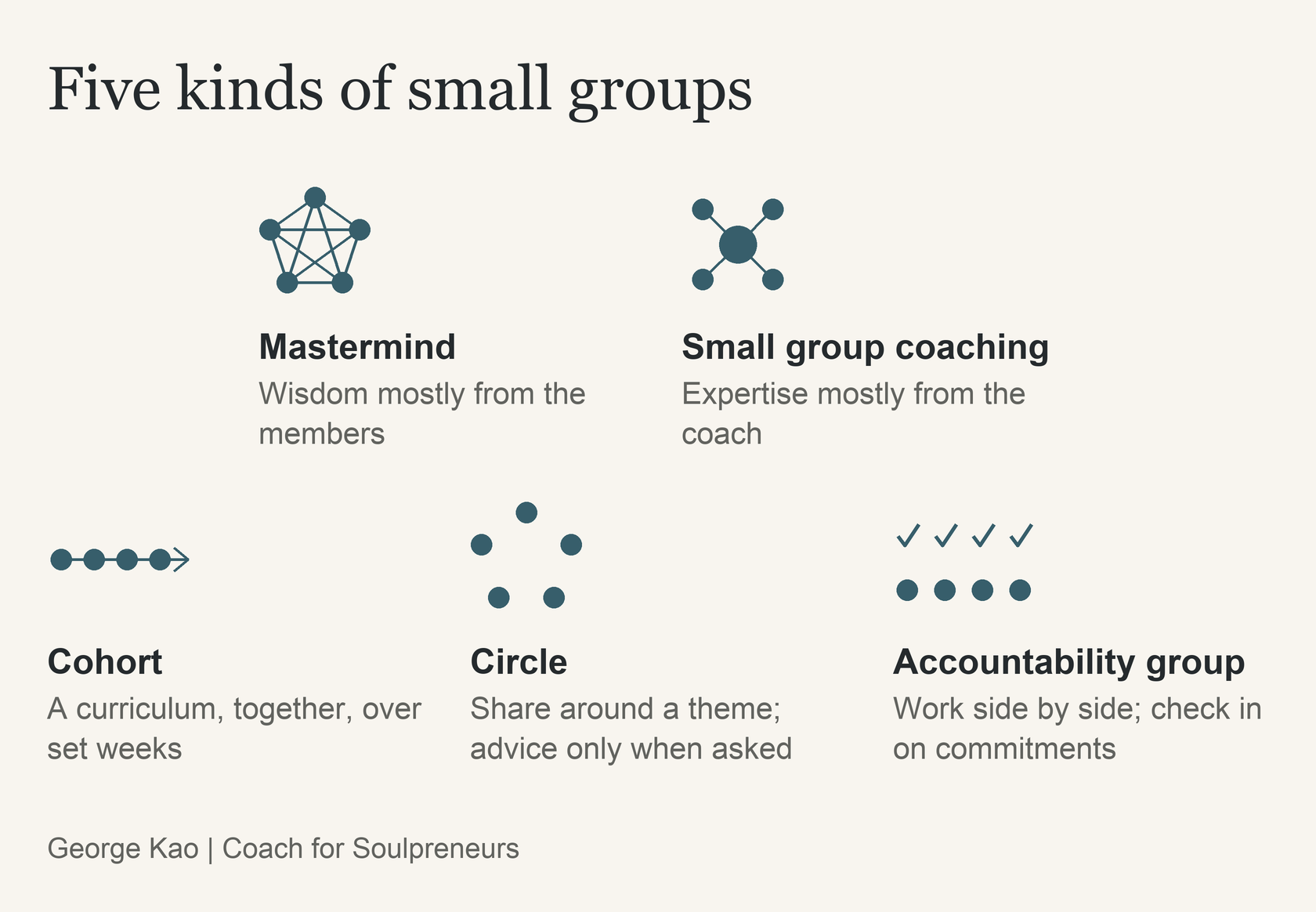
- Mastermind. Peers helping peers. A host facilitates, but most of the wisdom comes from the members, as each person brings their goals and challenges. It works best when members are at a similar stage, so they can relate to each other's situations.
- Small group coaching. A coach works on each member's situation while the others listen and chime in. Most of the expertise comes from the coach, so the coach's experience is a big part of why people join.
- Cohort. The group goes through a course or curriculum together, over a set number of weeks, with live sessions for questions and practice.
- Circle. Members share around a theme, such as a life transition or the year ahead, and the group listens deeply. Advice is offered only when someone asks.
- Accountability group. Members meet to work on their projects and check in on each other's commitments. Some of these are co-working sessions, where everyone works side by side on camera.
My next mastermind, for example, will mix in a bit of teaching, with ten minutes of framework at the start of each meeting.
If you're not sure which type to offer, you can poll your audience on which one they'd rather attend. And whichever you choose, name the type clearly in your invitation, so people know what they're saying yes to.
What makes a small group work:
Whether you'd like to join a group or start one, look for these six qualities:
- People you respect and enjoy. You'd much more likely sign up for an intimate group if there are people you respect and really enjoy being with. If you're the one launching a group, this means curating the members. Invite people you think the others would respect and enjoy… people at a similar stage, who share similar values about how they want to do business. A short get-to-know call before someone joins helps you both sense the fit. And when someone wouldn't be a good fit for this particular group, it's kind to tell them so, and point them to something that might serve them better.
- A specific topic. A general get-together for your audience isn't likely going to fly. People tend to join to get support for a particular challenge they need help with. Even a personal topic like stress works well, when it's stress about a particular thing/situation/passion/stage of development. The more specific the situation, the more likely the group will be valuable… and will gel together.
- Four or five people. My mastermind this year had five of us, including me, and that was a really good number for a one-hour meeting. Six would have made the hour more hectic, yet three would have felt too small. Jack Canfield, who largely popularized the idea of masterminds, suggests five or six. For me, four or five is the sweet spot.
- Paid. The people who care enough to pay something are much more likely to show up. (I've been part of free groups… have you? Do people show up?) I explain more in my post about free Facebook groups.
- A price that fills. If you're the one starting a group, it's okay to lower the price until the group is full… just above what I call your "minimum resentment rate," the lowest price you would charge without starting to resent the members of the group. You want people thinking, "Please, can I have one spot?" You can gradually raise the rate, with each new round, as you gain experience leading groups well. It's discouraging to set a price like $300 or $500, and then have nobody sign up. Of course, the group is worth every dollar! But people are scared to risk that much money without knowing your credibility with leading groups.
- A commitment people can make. The cost of joining is the price plus the time, and a whole year is a big ask. 3 months is easier to say yes to. A habits study found that a new habit takes 66 days, on average, to become automatic, so maybe 2 months could be a sweet spot to start with. Plus, a shorter duration means you get to harvest those lessons to launch the next group.
How I'd run a mastermind next time…
Next time I run a mastermind group, I'd make these changes:
- Rotate leadership. Each member would lead one meeting, or bring one insight or exercise to share, which also lets the group learn from each other's frameworks. I've done this in the past and it kept the group more dynamic. This year I didn't do it and it was a mistake.
- Pair members up to respond to each other's messages between meetings.
- Add more structure. I was too loose with our meetings ("Okay, go ahead, tell us what you'd like to talk about today…"). Next time, I'd open each meeting on last time's commitment: "How did it go with your webinar?"
- Open with ten minutes of framework teaching. The host shares only the next piece in the framework the group is working through, then members talk about that, or about what's alive for them right now.
- Share an occasional summary. At the end of our time together, I gave everyone a comprehensive and organized AI summary of our meetings. I should have done that along the way, so each person has more of a through line.
If you're starting one, here's how to fill it:
So few people launch small groups. Far more people would love to join one, than ever start one.
- Start with people who already know you. Your network/audience/past clients… the people who have done something with you before. A student in my case-study course recently emailed me. She personally reached out to her inner circle, using the Circles of Enrollment from The 7 Practices of Thriving Soulpreneurs, and two out of three said yes to her offer. People can feel your care.
- Beyond your inner circle, you need to get attention. There are two main ways, three if you have a budget. (a) You can be so insightful that people share your work and want to be near the conversation. (b) Or you can do netcaring and collaborations, reaching out with genuine care to the audience members who comment on your posts or who follow you (my post about Netcaring explains how). They may think, "Nobody does this!" People can instead tell, when a message is generic and AI-written. Let yours feel like it came from a real person. (c) And third, if you have the budget, ads can help a lot too.
- Co-create the group. Talk to your past members, audience members and colleagues about what they'd love in a small group. The more you involve your tribe, the more interested they'll be… at least to give ideas, maybe to join, or to share your group once it's ready.
- Answer "Who else is joining?" When I was admissions director for a business school, I recruited a lot of people, mostly by talking up the others who had already applied. Without naming names, I'd say, "You'll be with people such as the executive director of a nonprofit, a manager at…" You can do the same, with two or three short sketches of the kinds of people who are interested in your group.
- Pick a season… or test anytime. November and December are a lovely time, when people are looking forward to the next year. Spring has a feeling of growth and connection, and autumn has that back-to-school vibe. But really, any time of year is a good time to test whether you could get a group together.
- Test interest with a free webinar. Offer your webinar a few times, on different days, with breakout groups so that people get to meet each other. (I explain the format in my FTApr Webinar Strategy.) In November or December, that could be a session to reflect on this year and envision the next. Your invitation will sound different from all the year-end noise… trust that.
- Once you're ready to charge more, add one-to-one time with you. Include a one-to-one call with you at the start of the program, and another one at the end. (These calls could even double as interviews for a client case study!). You could also offer your group members a discount on extra one-to-one sessions with you, with a grace window after the group ends. It just feels generous, even if they don't book.
Two clients to check out:
As promised, here are those two clients, and what they're offering right now:
- Denitsa Atsova is opening The Resilient Growth Mastermind, a 12-week small group of up to six service-based soulpreneurs. She's hosting a free Intro Workshop in December. For a taste of how she holds a circle, read If your business was a book you're writing in real time.
- Marianne Nygaard is offering a free masterclass, Åbent hjerte, Stærk ryg ("Open Heart, Strong Back"), on personal leadership from the heart.
Your turn…
What has worked well about small groups you've been part of? What did you wish was different? And are you considering starting one too?
Share your thoughts in the comments… let's learn from one another's experiences. Thank you 🙏🏼🧡
Visit the comments section here (and feel free to add yours!)
