Should I Buy the Stock Everyone’s Talking About?

Since I post occasionally about investing, people sometimes ask me whether they should buy a particular stock that’s hot and in the news.
In short here’s my answer:
- If you don't know it deeply, buy a diverse basket instead.
- If you do know it deeply… then you may have earned a concentrated bet.
The standard reminder first: I'm not a certified financial advisor, simply a passionate amateur who has been actively investing since 2016. Please do your own research and get clear about your own strategy and risk tolerance. Then make your own decisions. You are responsible for them. 🙏🏼.
The basket: diversification as the default
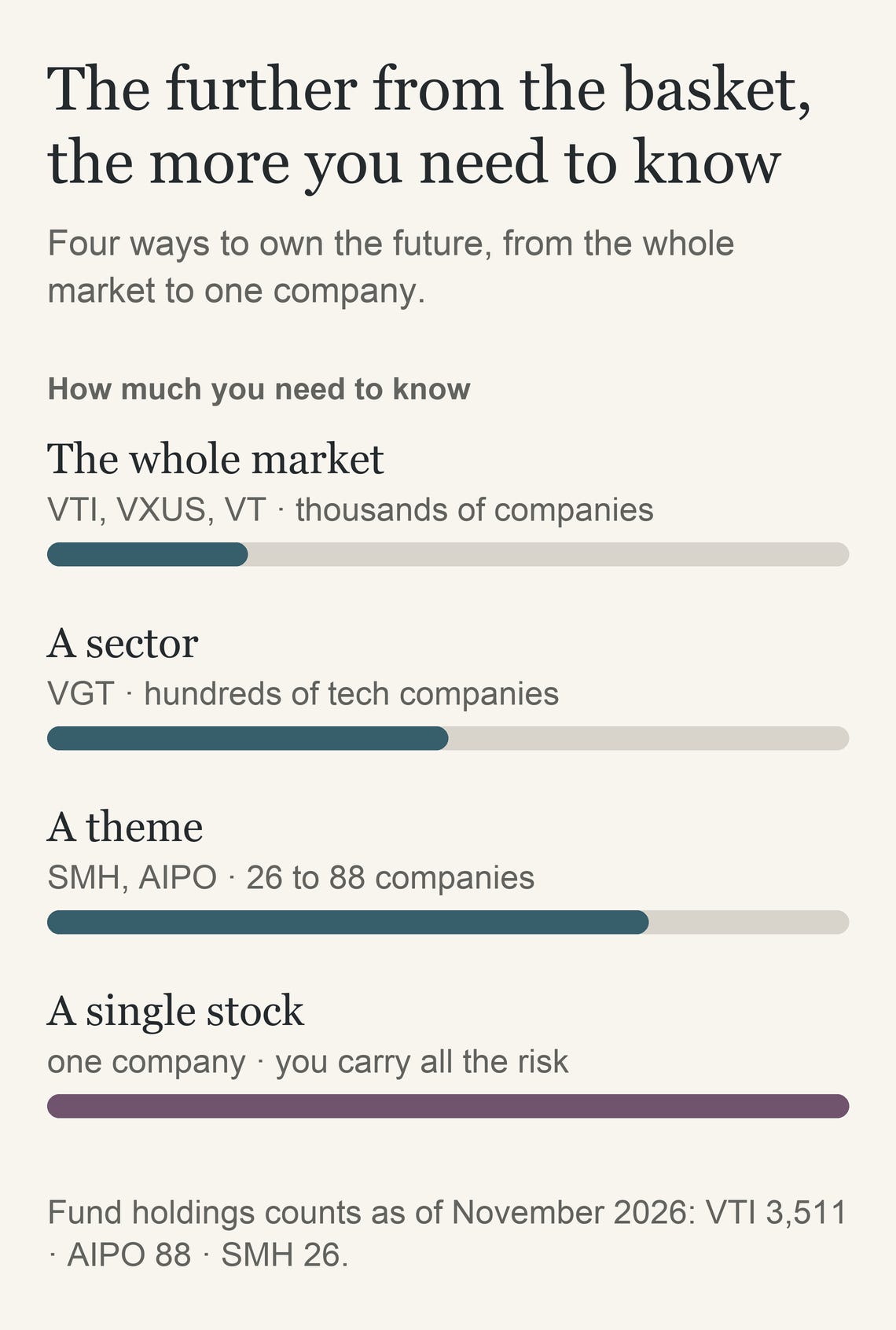
VTI holds the whole US stock market: 3,511 companies in one fund. VXUS holds the rest of the world. VGT holds the tech sector, hundreds of companies.
Even a theme fund is still a basket. SMH holds 26 of the world's biggest computer chip companies. AIPO holds 88 companies building the power and infrastructure behind AI. You get to bet on the theme without having to pick the winning company.
Note — I own shares in all of the linked assets (baskets) above.
With a basket, nobody has to know which particular company will win. The winners usually win so much that they more than make up for the losers.
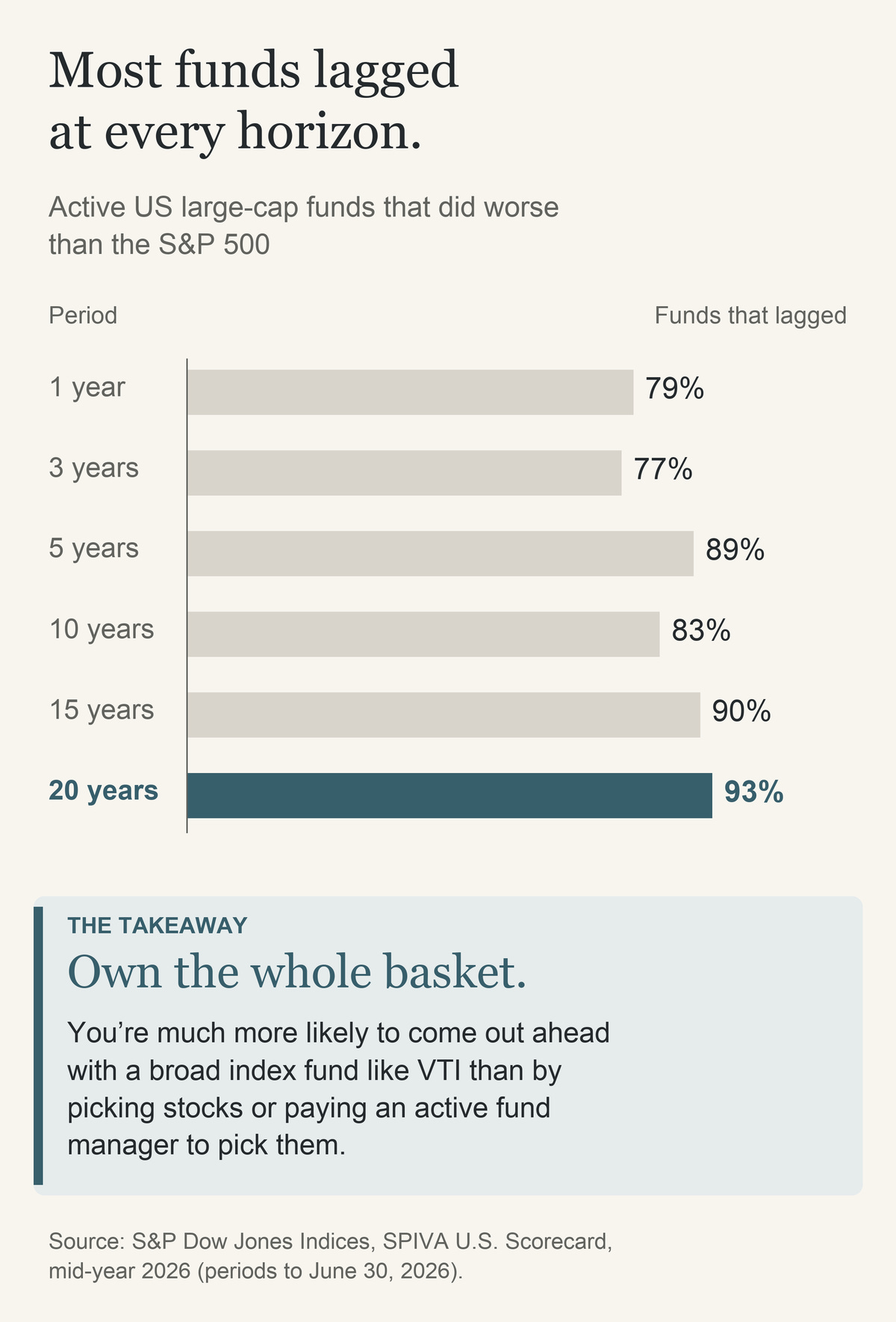
And picking winners is harder than it looks, even for professionals. Over the past 20 years, about 93% of actively managed US large-cap funds did worse than the simple S&P 500 index. If you’re interested in the S&P 500, I recommend buying VTI instead, which holds a more diverse basket but is still dominated by the S&P 500. VTI and other broad indexes have been beating actively-managed funds for decades. See the chart below.
Single stocks are tougher still: research by Hendrik Bessembinder found that most US stocks since 1926 did worse over their lifetimes than simple Treasury bills… and the best-performing 4% of companies created all of the stock market's net gains.
The rule for single assets: know it well enough to bet on its future
"Knowing" an asset means you can explain why it's likely to be worth more in ten years… and what would prove you wrong.
Knowing often starts as a user. You see a product up close, long before the analysts' spreadsheets do. But using a product only shows you its present. To own it for a decade, you must understand its future.
I use two guardrails. First, I decide in advance what would prove my thesis wrong, so a scary price drop isn't the signal… a structural change would be. And second, I regularly ask myself: would I buy this position today, at today's price?
My single-asset bets, and how I know each one:
In each case, I use what the company makes… and I understand where it's headed.
Anthropic (ANT)
I use Claude every day. It helps me run my business, and I teach soulpreneurs how to work better with their own AIs. That's knowledge from the inside, as a heavy user.
Today I own a bit of Anthropic through USVC, a venture fund with a stake in the company. Anthropic has now filed to list on Nasdaq under the ticker ANT.
I'm not going to chase the IPO excitement. I'll wait for the post-IPO dip, then buy in stages… the same boring system I use for everything else.
Tesla (TSLA) and SpaceX (SPCX)
Both my brothers drive Teslas and love them. Every time I ride in one, I love the experience too.
SpaceX listed on Nasdaq as SPCX in June 2026. SpaceX also owns xAI now, which brings in X and Grok, both of which I use and love.
On November 14, 2026, SpaceX caught a Starship with its launch tower after the ship had circled the Earth 14 times. It was the first time an orbital Starship has come home to the tower.
A caught rocket can fly again. And reusing rockets is what makes space cheaper.
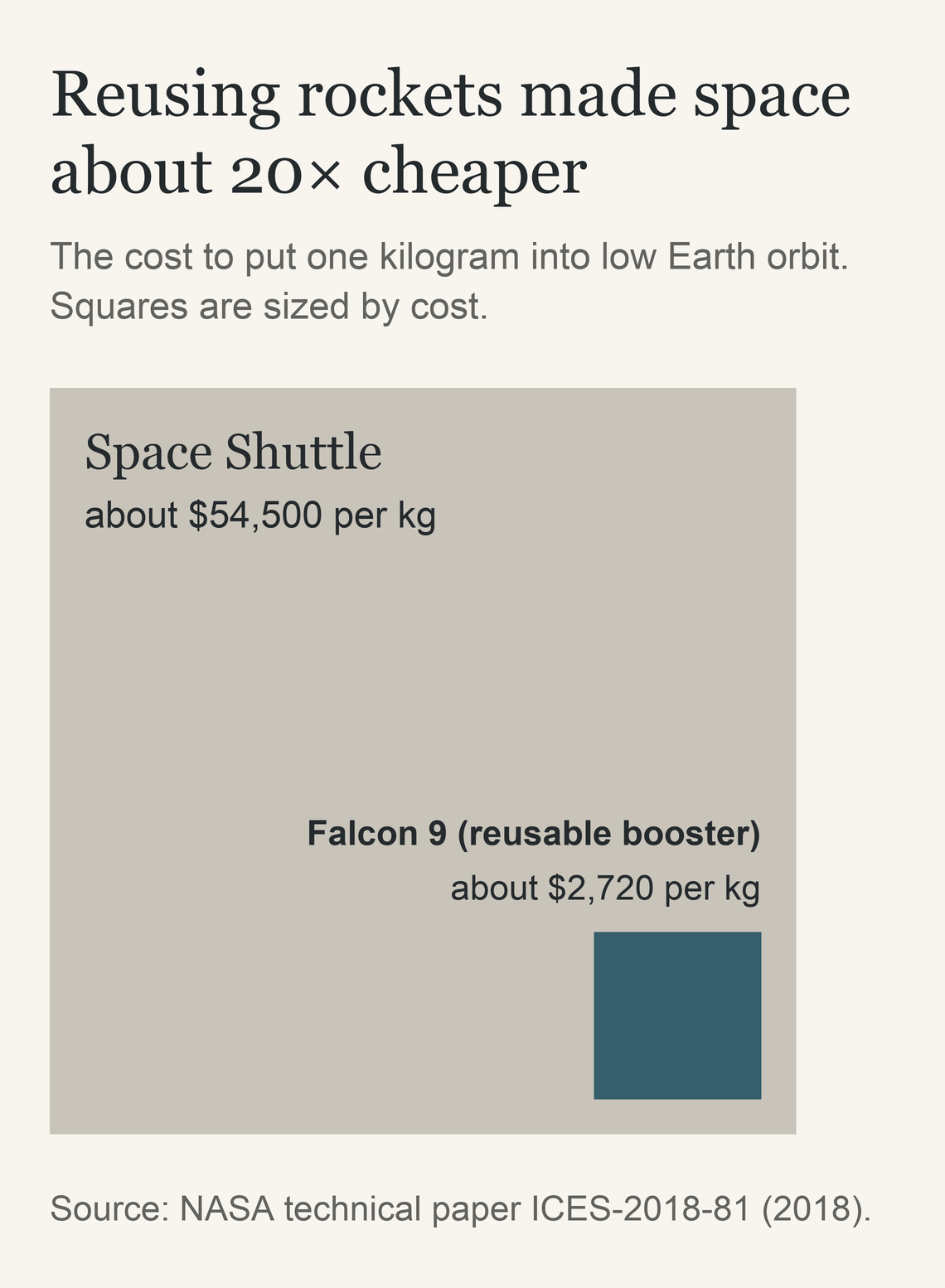
NASA's Space Shuttle cost about $54,500 per kilogram to put into low Earth orbit. SpaceX's partly reusable Falcon 9 brought that down to about $2,720 per kilogram, according to a 2018 NASA paper… twenty times cheaper. Starship is designed to reuse everything, like an airplane.
Cheaper launches mean cheaper payloads, which makes a whole space economy more viable: more satellites, more research, more services from orbit… and maybe even data centers in space.
AI runs on enormous data centers, and on Earth they take up land, power and water. Seven in 10 Americans oppose an AI data center in their own area, and in the second quarter of 2026 alone, at least 45 US data center projects worth $68 billion were blocked or delayed by local opposition.
In orbit, there's abundant sunlight, and no neighbors to object. SpaceX has filed with the FCC for up to one million satellites for an orbital data center network, and Musk has said that within about three years, space will be "by far the cheapest" place to run AI.
So I believe SpaceX will be one of the world's largest companies by 2040… possibly the largest.
Strategy (MSTR) and Strive (ASST)
I use and love their income products: STRC from Strategy (MSTR), and SATS from Strive (ASST).
And both companies are built on bitcoin, which I know better than any other investment I own.
Use AI to help you analyze… and know its bias
Whatever you're considering, AI can help you study it: its likely future, its biggest risks, and what would prove your thesis wrong.
But know that AI tends to be very conservative about investments. For example, I had to tell my AI that I have conviction in bitcoin's future, and to treat bitcoin with that respect.
Here's a prompt you can copy, if helpful:
I'm considering investing in [asset]. Please analyze it as a 10-year hold: its likely future, its biggest risks, and what would prove the bull case wrong. Don't sugarcoat the risks of this individual asset. I have real conviction in it because [your reason], so please take that seriously instead of defaulting to caution. If I do invest, how could I enter cautiously, in stages? And if I'm not sure enough, which diversified funds (like VTI, VXUS or VGT) or income-producing investments (like Strategy Inc’s STRC or Strive Inc’s SATS) might serve me better? Thank you for thinking this through with me.
The twist: bitcoin isn't one asset
The usual financial advice goes like this:
Putting a big share of your money into one asset is the opposite of diversification. If that one asset fails, you lose.
But the more I've studied bitcoin, the more I see that it isn't one asset at all.
Bitcoin is held up by at least nine groups of people. Each wants it to succeed for its own reasons… and no single one of them could sink bitcoin on its own.
Here they are, with numbers as of November 2026:
- Miners. Bitcoin's network now runs at about 970 quintillion guesses per second. Even if every machine were today's most efficient model, that would take more than 3.5 million mining machines… and the true count is higher, since many machines are older models. Those machines are organized into 33 mining pools, and each pool is made of many miners: just three of the smaller pools that publish their numbers count about 38,000 users running about 290,000 machines between them. Home mining is growing too, with over 100,000 small Bitaxe home miners sold. Mining is spread across more than 10 countries, and no single country has even 40%.
- Decades-long holders (the "bitcoin maxis"). About two-thirds of all bitcoin hasn't moved in over a year. About 3.6 million bitcoin, roughly 18% of all mined so far, hasn't moved in over ten years. Some of that is lost… either way, it's not for sale.
- Institutions. US spot bitcoin ETFs hold about 1.26 million bitcoin, about 6% of all the bitcoin that will ever exist. BlackRock's IBIT alone holds about 783,000. Add 197 public companies holding about 1.24 million bitcoin, led by Strategy (about 850,000) and including Strive (about 43,000), plus 71 private companies.
- Node runners. About 104,000 computers check every transaction and enforce bitcoin's rules, and 19,070 of them are publicly reachable, in 96 countries. Even miners can't change the rules without them.
- Governments. 13 government entities hold bitcoin. In the US, Texas passed a law in 2025 creating a Strategic Bitcoin Reserve.
- Builders. 1,374 people have contributed code to Bitcoin Core. OpenSats has funded 252 developers and projects in 40 countries, and the Human Rights Foundation funds bitcoin tools for activists.
- Everyday savers. An estimated 300 million people around the world own bitcoin. That's about 1 in 25 people on Earth. If bitcoin owners were a country, they'd be the world's fourth-largest, bigger than Indonesia (about 288 million people) and behind only India, China and the US.
- Businesses. Square switched on bitcoin payments for about 1 million US merchants in May 2026, and Morgan Stanley's E*TRADE now lets its clients buy and hold bitcoin directly.
- The wider crypto industry. Bitcoin makes up about 59% of the entire crypto market's value (about $2.2 trillion in all). More than 220,000 bitcoin have been "wrapped" onto other blockchains like Ethereum, where they're used throughout the rest of crypto. The whole industry has a big stake in bitcoin doing well.
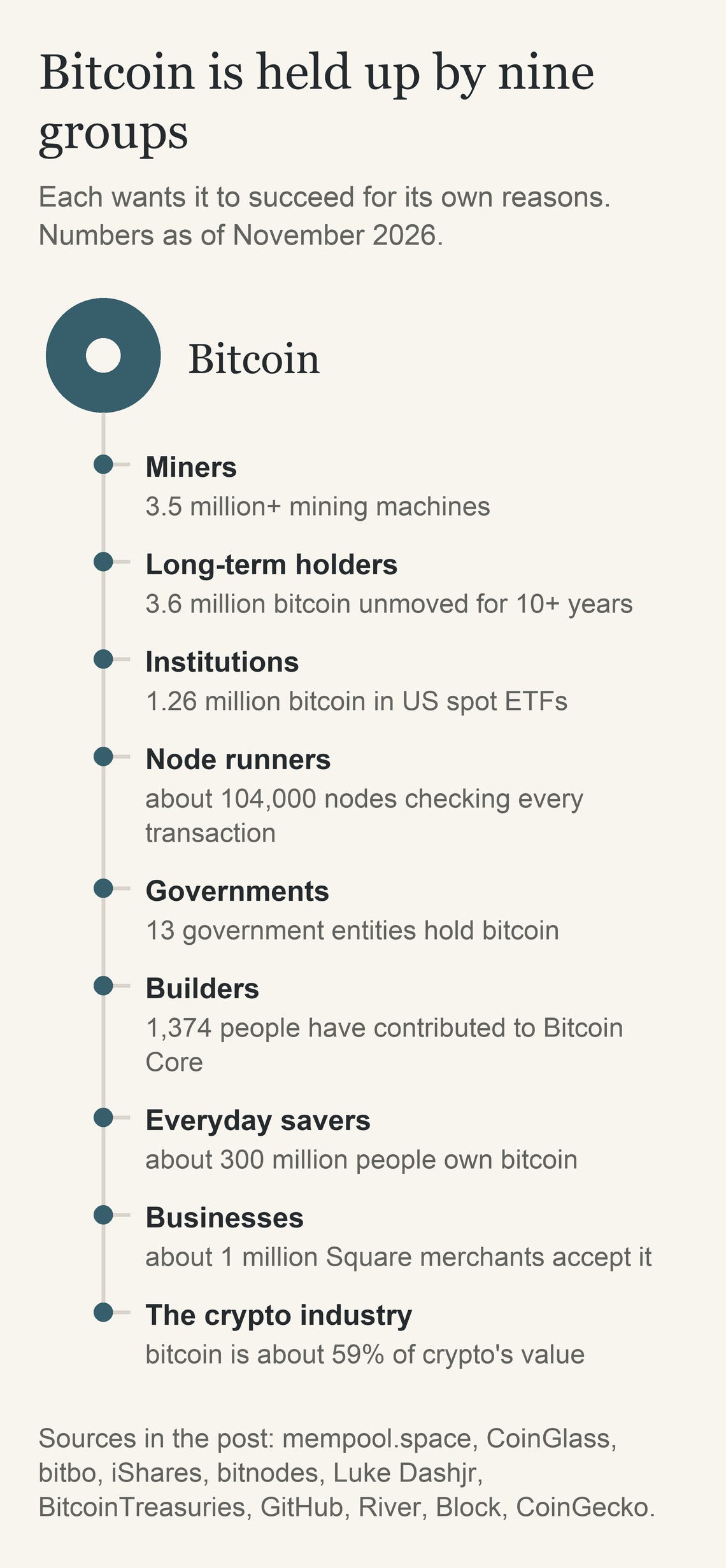
If one group weakens (a mining ban somewhere, an ETF outflow, a government selling), the others keep bitcoin standing. Like an index fund, bitcoin spreads its strength across many hands with different motives.
So my bitcoin conviction is less concentrated than it looks.
For the record, I hold my bitcoin through IBIT, in a regular brokerage account. I don't self-custody, and there are no keys at home. I've written more about why I believe in bitcoin in Why Bitcoin Is Good for the World.
Not everything in one basket… even VT
Even with all that conviction, I don't put everything into bitcoin.
And I wouldn't put everything into VT either, even though it holds thousands of companies around the world. But VT holds only one kind of asset, which is stocks. When stock markets fall together, VT falls with them.
So I spread my money across four buckets, each with its own job. See my approximate allocation here: Where I Invest My Money.
If one bucket has a terrible year, I'm not forced to sell anything. The savings bucket (the dividend stocks) keeps paying… and gives me dry powder to buy the dip of any of the other categories.
How to apply this to your own money:
Start with the basket. Broad funds can carry most of the weight.
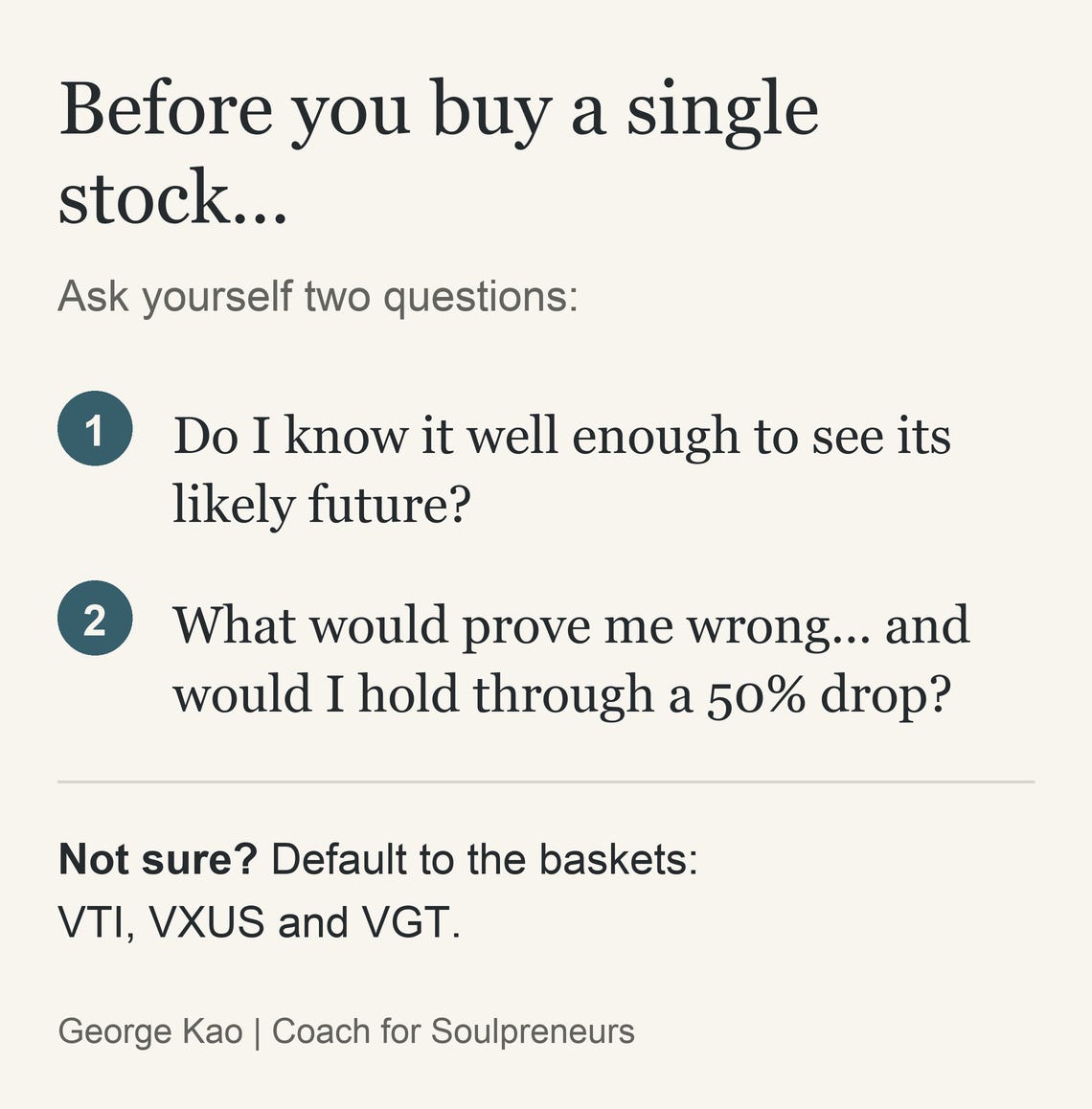
Then, for any single asset that tempts you, ask these questions:
- Do I know it well enough to see its likely future?
- What would prove me wrong… and would I hold through a 50% drop?
Then let AI stress-test your answers, with the prompt I shared earlier in this post.
Not sure yet? Then it's wise to default to the baskets: VTI, VXUS and VGT. Excited about a chip company, but don't know it deeply? Chances are SMH already holds that company.
And for steady income, I like income-producing preferred stocks like STRC and SATS. Right now STRC pays 12% a year (Strategy Inc. sets its rate monthly), and SATS pays a fixed 15%. In my view, these are more likely to compound at a better rate than most individual stocks or actively managed funds.
Sleeping well at night…
What I'm after is a boring system on purpose… one that lets me sleep well at night.
If you're wondering how this fits into a whole plan (saving, investing, and eventually living off the income), I lay it out in A Simple Plan for Financial Freedom.
What's one asset you know well enough to see its future? And which one will you research next? Share in the comments. 🙏🏼🧡
Visit the comments section here (and feel free to add yours!)
