Will AI make your business obsolete? What to do in the next few years.

Many of you have written to me about AI recently… some version of: is it still worth creating anything?
Usually it starts with a scary video that someone sent… AI will takeover all jobs; it'll make my business obsolete…
I know that question all too well.
Let me start with an encouraging and true statement:
No, you're not "behind."
And, hardly anyone else is ahead, either.
Those frightening videos are almost all about how the machines are getting smarter.
What's more practical for us to pay attention to is — how fast are people actually changing the way they work and live?
Those two numbers are wildly out of step right now. And the space between them is your opportunity in the next few years.
(If you're still reluctant to use AI, you might first consider reading my letter to friends who are feeling uneasy about AI.)
Two curves, and the space between them
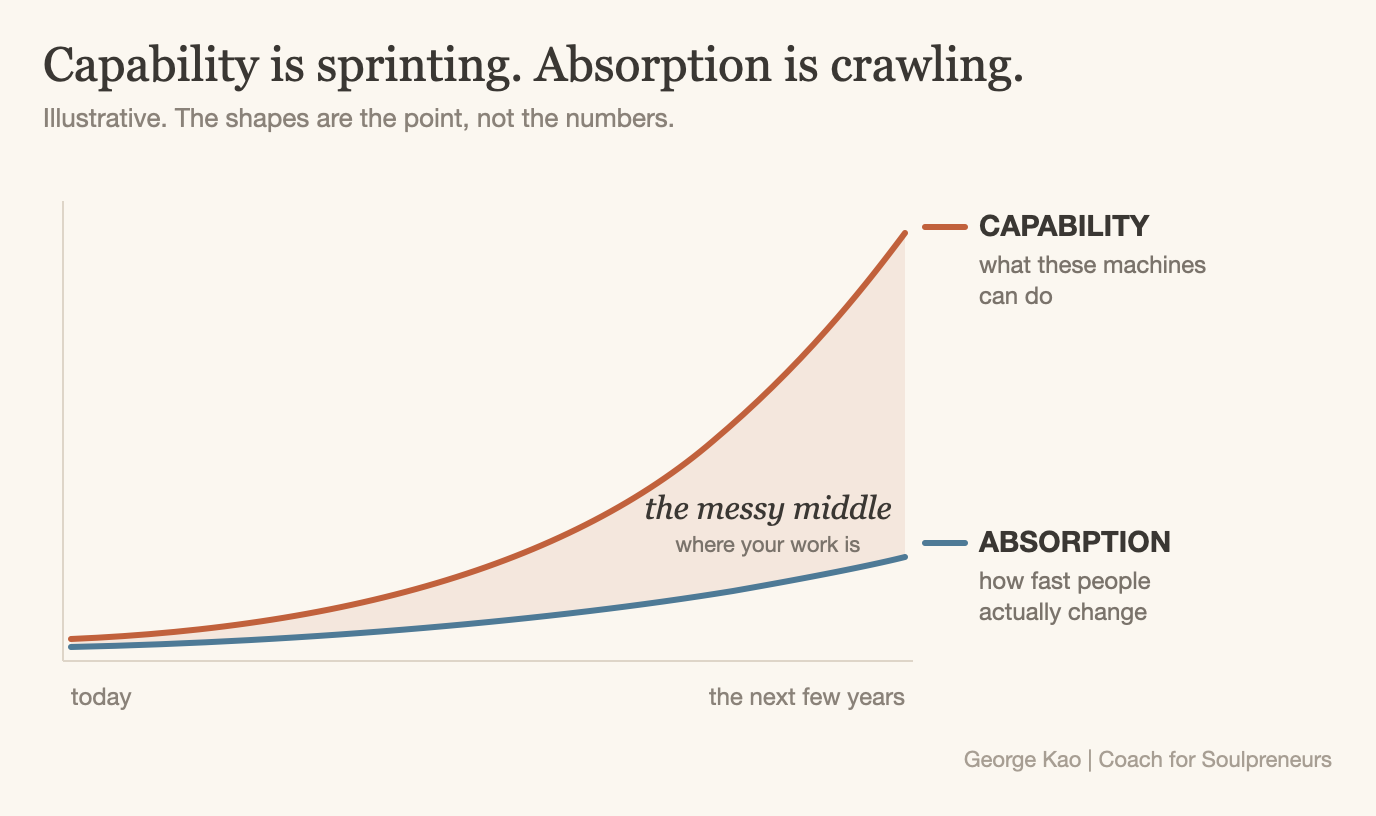
Capability is sprinting. What these machines can do keeps roughly doubling on a timescale of months.
Absorption is crawling. Most organizations, and most people, have changed very little about how they actually work.
Recent research from the Federal Reserve put it about as clearly as economists ever put anything: "strong benchmark performance does not necessarily translate into the ability to complete actual on-the-job tasks." The productivity gains they can measure at the micro level, they wrote, are "not adding up in aggregate."
Around 95% of company AI pilots have produced no measurable return. The Yale Budget Lab still sees no economy-wide disturbance in the labor market.
Both of those things are true at once. So what?
The space between them is where opportunities emerge.
The messy middle
There's a name for that space now, and I like it.
Molly Kinder — she founded an organization about AI and careers, and co-chairs New York's future-of-work commission — calls it the messy middle. Between today's mild measured impact, and Silicon Valley's post-AGI world of "a check and a hobby," there's a long stretch where AI is capable enough to take real tasks… so some work reprices, while most of the labor market holds steady.
Her read is that it's the inverse of COVID.
In COVID, the laptop class was safe, and the in-person workers carried the risk. If thinking-work becomes cheap, that flips. Manual, in-person, interpersonal, unstructured work becomes the protected category — and she puts something like 50 to 60% of the workforce there, with economically viable general-purpose robots "many many years off."
One human co-regulating with another human while they process and work on themselves, is about the least automatable work there is.
A lot of people are about to need what we do…
…and many of them will finally have the time to receive it.
Kinder also looks at the exposed side of the same picture. About 16 million Americans work in back-office, clerical and customer-service roles. In most metro areas, it's the single largest group of jobs. Mostly women.
AI is coming for those jobs first. And every one of those souls is going to need support while they work out what comes next. Unlike almost any other moment in a working life, a lot of them will finally have the time to go looking for that support… and the space to actually take it in.
Being between things is often when people finally get to what they've been postponing. They will need support in all kinds of ways.
You can be there for them.
The next 5 years
Honestly, nobody can realistically create a five-year plan by this point.
The best-known AI forecaster moved his own headline date four times in eighteen months — 2027, then 2028, 2029, 2030, then back to 2028 — and his own co-author forecasts the big changes for several years later.
The uncertainty is real.
So the five-year move is to choose things that pay off across the whole range of possibilities.
What to do:
- Build a body of work you own. Writing, recordings, a corpus that's yours and portable — meaning you hold the actual files, not just a login. Platforms change their terms and their algorithms, and some of them disappear. Anything you can't export, you're only renting. It's also what you'll feed your AI so that it can sound like you, and that only works if you have it in hand. (If you use AI a lot, I've written a free guide about having your AI context be portable here.)
- Deepen your meaningful connections. These survive platform shifts and algorithm changes. We'll need each other even more in the coming years.
- Learn the tools that are making work more efficient. It's one thing to read about how AI is getting smarter. It's a totally different, and much more empowering experience, to actually put it to work for you.
What not to do:
1. Don't build anything whose value is "I know this and you don't."
Information asymmetry is the asset class that will most reliably be erased.
Move away from making offers that's primarily about knowledge transfer.
2. Don't reorganize your life around a doom timeline.
Reassurance is cheap, and you've had plenty of it lately. Evidence is better:
Remember the ozone layer? In the 1980s that was a measurable, planetary emergency. The Montreal Protocol, signed in 1987, went on to become the only treaty in the history of the United Nations ratified by every single nation on Earth.
And it worked. The ozone layer is now on track to return to its 1980 levels around 2040. Last year's ozone hole was small, and short-lived. There was even a side effect nobody designed for: the UN's own assessments estimate the phase-out avoided roughly half a degree Celsius of global warming.
Another example — the global nuclear stockpile peaked at around 70,000 warheads in 1986. Today it's about 12,000 — a reduction of more than 80%, negotiated across decades when hardly anybody believed it was achievable, by people who did not like each other.
In both cases, what decided the outcome was what people did after the alarm. The world is just now starting to see the alarming rate of AI growth, and governments are starting to mobilize.
3. Don't wait for a clear signal before you adapt.
This is the counterintuitive one. The big AI labs are automating their own work first. Which means the broad, gradual, obvious wave of job disruption — the one that would give all of us plenty of time to see it coming — is not yet on the immediate horizon.
One more thing about five years:
That same forecaster was asked what he tells his own daughter to study. He didn't name a skill. He said: try to be a good person, and do things that are worth doing for their own sake, because planning for a "successful" career around this isn't reliable.
I found that oddly steadying. Under this much uncertainty, it may simply be the most rational answer…
And it happens to be what most of us were trying to do anyway. 🙏
The next 1 year: work the messy middle
What to do:
Action 1. Your people are (going to be) stuck in new ways — follow them there, in your own area of expertise.
A health coach's clients can now get a personalized meal plan in thirty seconds… and yet, probably still won't follow it.
A therapist's clients arrive having already talked it through with a chatbot at 2am, and yet, still stuck in their head about it.
An art teacher's students can generate a finished-looking image in ten seconds, and have stopped learning how to see and visualize more creatively.
The stuckness simply moved… our craft needs to address a higher level.
You don't need a new topic. You need to notice where your own topic is now relevant.
Action 2. Automate the tedious parts of your work; free up time for your best work.
This is the one place where AI is unambiguously on our side. It gives you back the hours, and you spend them on the work only you can do.
A few of the things that my AI agents handle now:
- Draft and schedule content posts across five platforms
- Checks my social media notifications for anything worth responding to
- Handles most of my course launch and operational logistics
- Pulls my website search data, and tells me which older post to refresh next
- Turns a teaching session into finished course lessons, uploaded and announced
- Makes my cover images for content, courses, website
None of that is my actual work. All of it used to take up my energy.
My sense is that most people are tapping maybe 5% of what AI can now do. They're using it like it's still 2023 — not realizing that these tools now expertly operate your computer and your browser. I've recently taught a course on How I Set Up My AI.
If you have trouble knowing where to start automating, pick the task you resent most for its tediousness.
Action 3. Teach practices, not information.
A practice can be taught forever, because people need company while they do it.
Information can be taught once, and then it's a free answer in a chat window. (I've written about deliberate practice.)
Action 4. Sell your judgment, and your accountability.
These are the two things nobody gets from a chatbot.
Not because a machine can't produce an opinion (it can, cheerfully!) but because it can't be the one who's on the hook with you.
Action 5. Raise the floor of your offers deliberately, before you're forced to.
When a task gets cheap, expectations rise to absorb the surplus. That happens to your offers whether or not you decide anything… better to move on purpose.
This one has real numbers behind it, measured in actual transactions:
- Freelancers doing more complex work with AI: earnings up 45% year over year. AI-augmented professional services: volume up 72%, earnings up 22%.
- Meanwhile the commodity end — the "make me forty social posts" kind of work — saw per-contract earnings fall 13%. One major marketplace's revenue dropped 15%.
The commodity rung is getting busier and cheaper. The rung just above it is getting busier and better paid.
So the choice in front of you is which rung you'd like to be standing on.
What not to do:
1. Don't launch a course whose core value is information transfer. It'll be outcompeted by a free conversation before it earns out.
2. Don't compete on volume. Content creation is now the single largest category of what people worldwide use AI for. Volume is the one axis where you'll never be the cheapest.
3. Don't assume "relational" automatically means safe—
People already bring emotional and companionship needs to a machine. You can see it in how these assistants actually get used.
What it doesn't touch is being known over years, being on the hook with someone, and being in co-regulation with another human.
Continuity, and being answerable to another human, will sustain. We soulpreneurs already build our work that way.
The next month:
Five years is a posture. One year is a direction. This is what you can do now:
1. Draw the line, on paper. What may AI touch in your work… and what may it never? I've written about where I draw mine.
2. Hand one recurring task to your AI this week. Start with just one, the task you resent most.
3. Have one market-discovery conversation about stuckness. Ask people where they've been stuck, or what they're concerned about, since AI arrived.
The stuckness is the offer.
4. Do one thing with no leverage at all. Something that doesn't scale, and isn't content. A call with no agenda. A handwritten letter to someone. The capacity to enjoy unleveraged time is worth protecting on purpose.
May the work that matters most to you, be the work that these next few years give you more time for. 🙏🏼🧡
Your turn…
What's the one thing you've handed to AI that you'd never hand back — and the one thing you tried, and then took back?
Visit the comments section here (and feel free to add yours!)
