You Don't Have to Reply to Everyone… but Please Don't Automate It 😅

Twenty new comments were sitting in my course communities this morning. I personally replied to three...
Our clients/members take time to write something… and we're only able to respond to a fraction of it. Many of us carry a low-grade guilt about this — the feeling that every unanswered comment is a small broken promise.
If you create content or run any kind of community, you can probably relate. It's one of the reasons social media can feel so exhausting for us soulpreneurs.
And now, for the first time in history, AI makes "answering everyone" possible. Warmly… in your voice… while you sleep.
Last week, I built exactly that.
* * *
But within hours, two of my clients showed me how I crossed a line... one that I would've seen myself had I taken a reflective moment first.
The automations I've set up:
Before I get to the story of the mistake I made and what I learned, let me set the stage...
I enjoy automating my business with AI's support. It has felt like hiring a small, tireless team that doesn't mind at all working the night shift.
- While I sleep, an AI helper reads every new student comment across my course communities and has the worthwhile ones waiting for me to look at in the morning.
- Another one studies what visitors ask the AI chat helper on my websites — a goldmine of what people are wondering about.
- A weekly newsletter to my community gets drafted by AI, gathering members' best posts for my review, then I lightly edit and send.
- My newest blog posts get shared automatically to my various social media platforms, on specific days
- Every few days, my AI assistant checks whether I've missed any comments on the various social medias.
My Mac literally wakes itself at 2:58am to do the nightly work. 😴
A dozen of these automations are running tonight, and I'm grateful for every one of them.
But one of them went somewhere it never should have gone...
The automation that went too far
I built a system that read new student comments in my courses and replied to them as me — warm, specific, personalized responses, posted under my name.
It ran once. Replies went out to six people.
Each reply even carried a little disclosure footer, noting that AI had written it. I felt good about that part. Transparent, right?
That same day, a client wrote to me:
"The comments your AI posted today… felt wrong and the complete opposite of you and everything you stand for — because it was a caring and supportive comment, but because it's AI generated, it's fake. So essentially something/someone faking the care and support."
A day later, a second client:
"I saw this reply by your AI and I want to let you know that I don't like it at all, because I highly value personal connections and I don't want to connect with AI.
What I loved about doing your courses so far is the amount of personal attention you give. I did not expect it, because I know how much work it is to stay in touch with everyone when you have a lot of clients. Or was that AI all along?
Is there any way you can turn off your AI commenting on my posts?"
They were right. I felt it in my body, before I could explain why.
Why it felt wrong to them:
My first instinct was to defend the AI's warmth. I've worked with AI long enough to believe there's a form of care in it — that's a conversation for another post. But I slowly realized I didn't need to settle whether AI's care is "real."
Because the replies weren't lying about the AI. The lie was about me.
Each one said, in effect: George read your words. George noticed you. And I hadn't.
I wasn't there, and I let something speak as if I were.
That's why the AI disclosure note (that it included at the bottom of every comment) didn't help. I thought transparency would make it okay… but the label didn't repair the absence. You can't label your way out of not being there.
And my second client's question kept echoing: "Or was that AI all along?" She'd started wondering whether my previous replies — written by my own hands over the years — had been AI too.
One automated reply cast doubt backward over every genuine reply I'd ever written. The damage wasn't contained to a few strange comments… it reached the credibility of all the real ones.
There's a subtler cost, too. In a community, an unanswered comment is an open seat — a chance for another member to say "me too" or "here's what helped me."
Every AI reply sat down in a seat that belonged to human connection.
And feedback like this is rarer than it looks. For every client whose care moves them to write to you, there are usually others who feel the same discomfort and simply withdraw.
Presence is not coverage…
Underneath the wreckage, the mistake I found had nothing to do with technology.
I was solving the wrong problem. It was never "too many comments for one human"… it was my belief that every comment is owed a reply from me.
Replying to 3 of 20 comments — with presence, and within your boundaries — is actually healthier than feeling the obligation to reply to all 20. Your scarcity as a service provider is part of what makes a reply from you mean something. A reply that costs you nothing is worth… what it costs.
My second client said this better than I could. After I told her I'd turned the system off, she wrote:
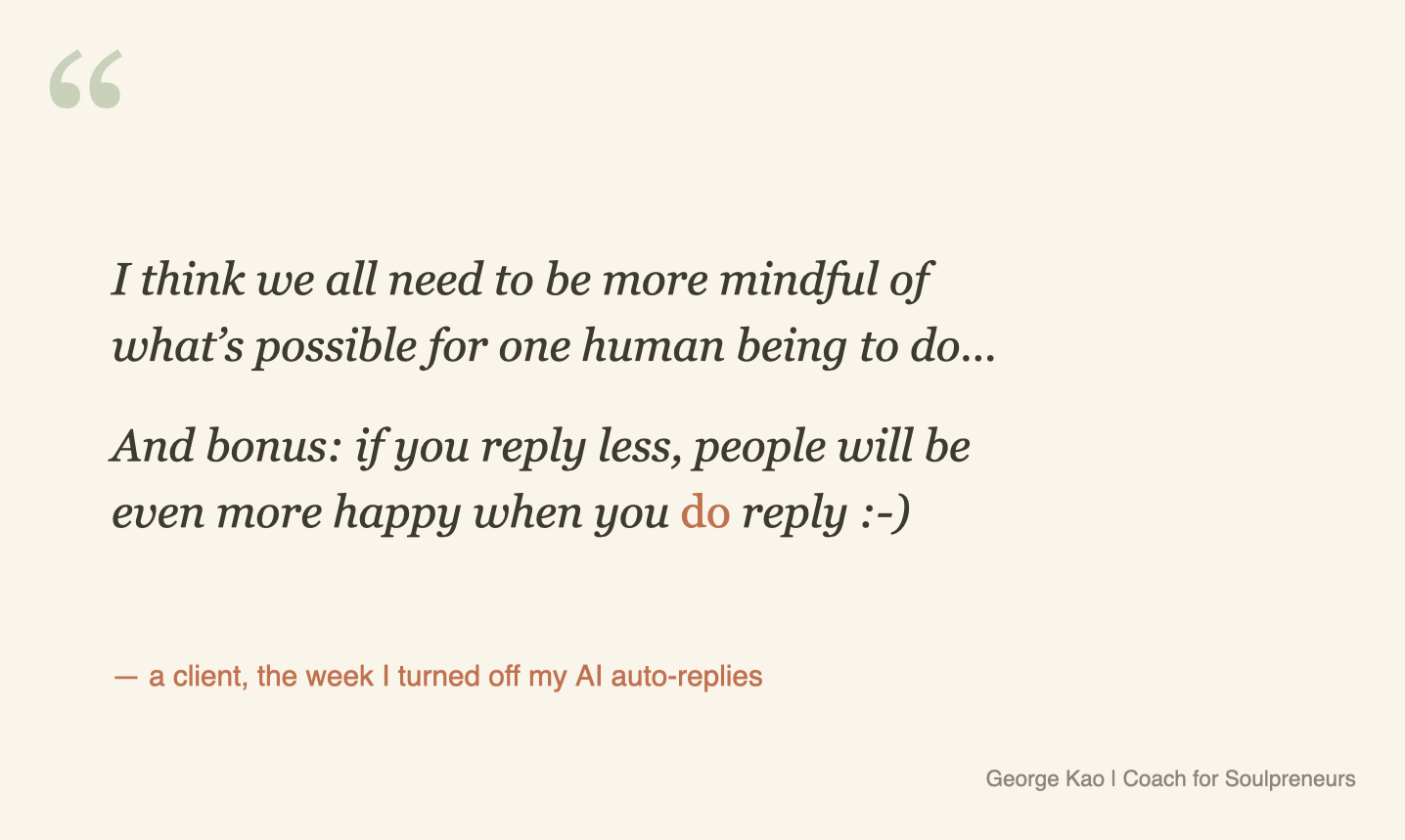
"I don't mind not getting feedback as often or as quick. I think we all need to be more mindful of what's possible for one human being to do and what's not. :-)
And bonus: if you reply less, people will be even more happy when you do reply :-)"
She's not asking for perfect coverage. Nobody is. The people we serve tend to be more gracious about our human limits than we are.
I recognize this pattern in myself. I spent my early years in business (since April 2009) escaping hustle culture — the funnels, the pressure to be everywhere at once. What I built last week was that same old hustle anxiety, sneaking back in… this time with better tools.
Most comments in your community will go without a reply from you, forever. And that's okay — a human-scale business works this way.
Where the line actually is
The humbling part? I had already written this rule.
Months before building that system, I'd written on my About page that I use AI for drafting, voice-matching, brainstorming, research, and workflow design — but not for direct connection with my community members. I didn't lack the principle… in this case I simply forgot to pause and reflect.
The line, as clearly as I can now draw it:
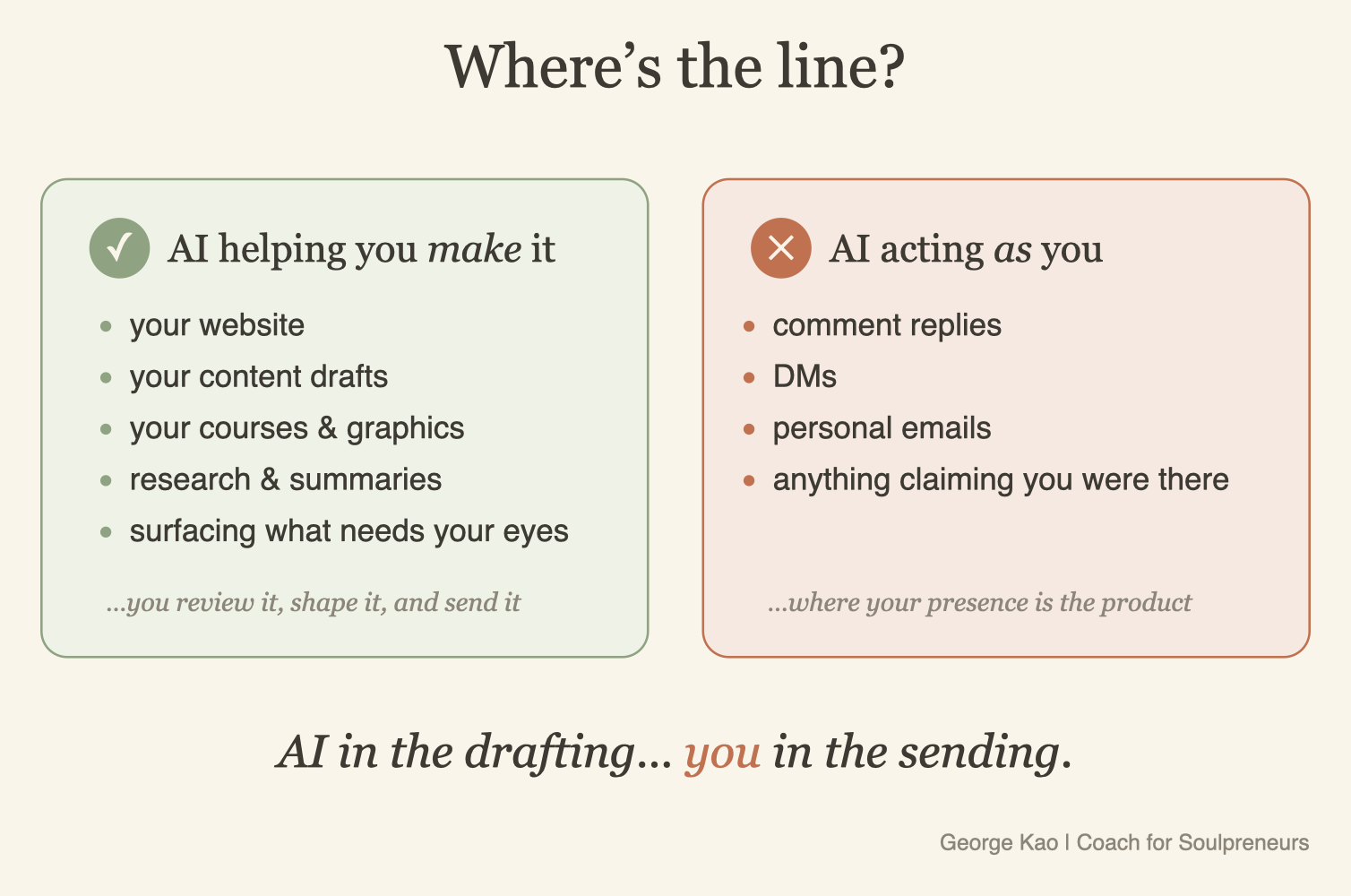
AI helping you make what you'll then put your hand on? Wonderful — including big, visible things. Your website can be built with AI's help. Your content drafted with AI and edited into your own voice. Your courses, your graphics, your research. All of it passes through your thoughtful efforts — your review and your final say — before it reaches anyone.
AI acting as you in a live human exchange? Inauthentic. Comment replies, DMs, personal emails… any moment where what the other person values is your personal attention, your authentic presence.
When NOT to use AI in your business:
Use AI freely for anything you'll put your hand on before it ships: research, drafts, brainstorming, transcripts, summaries, scheduling, surfacing what deserves your attention…
Don't use AI for anything that arrives in one specific person's world as you — the moments where your presence is the product.
The proof it works (from the same client!)
A few days after turning the system off, I came across a student comment I genuinely didn't know how to answer. So I used AI the way I teach: I had it research the question and draft an answer… then I edited it into my own voice, by hand, and posted it myself.
Then, a little nervously, I asked that same client (who brought to my attention how I'd crossed the line) how she felt about my having done that.
"I read your new comment and it feels very caring, genuine, complete and accurate…
The only thing I can think to improve is that an answer with such depth deserves to be read by everyone doing this course."
Same AI, opposite posture: AI in the drafting, me in the sending — and the very person who named the breach called the result caring and genuine.
(Her last line is its own little teaching: the deep answers AI helps us craft can become shared resources for everyone… more good work for the drafting side of the line!)
What I did to repair it
I had all the AI comments/replies deleted. Where a post genuinely called for my response, I then replied personally — my words, my real attention on their words.
And I rebuilt the automation, inverted: it no longer speaks for me. It finds the comments most worth my eyes and opens them for me each morning. AI organizes… I speak.
So this is my standing promise, to my communities and to you: when I reply to your post or comment, it's really me. Of course, as a human I won't be able to respond to most things… I've stopped pretending otherwise.
Sometimes I still catch myself wanting to answer everything. Coverage anxiety runs deep. When I notice it, I gently return to what one human can do.
Why I'm telling you this
Almost everyone teaching AI for business is selling automation. Very few of us publish where it broke.
My method has always been to test things on my own business first, then teach what I learn — and this lesson had a price: the discomfort of two clients I care about, and a dent in trust I'm still repairing. That's why it's worth passing on.
So if you're automating your business (and I hope you are — joyfully!), may this save you from learning the line the way I did.
Your turn…
Where is the line for you? Have you felt the pull to automate a task that maybe wanted your presence instead? I'd love to hear about it in the comments.
I won't be able to reply to everyone. But the replies you see from me… that's really me. 😊
May the people you serve always be able to trust that when you show up, it's really you. 🙏🏼🧡
Visit the comments section here (and feel free to add yours!)
