To My Friends Who Are Feeling Uneasy About AI...

Some of my closest friends, family, and clients are uneasy about AI.
In fact, in many circles, it’s actually shameful to use AI, or to be openly enthusiastic about it (as I am!)
People have raised specific objections to me. I’m grateful. This post exists because of those conversations.
What they feel is that important things are being lost, and that the people rushing ahead (the accelerationists) aren’t slowing down long enough to respect or even notice the loss…
So this article is lovingly written for those of us who feel some unease.
And here’s where I stand, so you know my position from the get go:
I think it’s happening regardless. We might as well use it wisely.
I’m not trying to convince you. I know I can’t. What would I most like? To see less suffering about a technology that’s being widely embedded, into all aspects of society, and, to see more thoughtfulness in how we use it.
So, I’d love to hear what you wish I could see instead, or what you wish I could believe differently.
Before we continue, let me first get the most popular objection out of the way: AI uses too much energy and water. I’ve already written about that here.
This article instead is about our inner sense of unease with other aspects of AI.
Where I think the unease is right
Creating has become easier than ever. This makes human discernment — taste — worth ever more going forward.
It’s as if all of us were handed a set of templates. And too many are using the templates without much thought.
So when someone sends me sixteen AI-generated pages where one paragraph would have done, it’s not really the tool’s fault. It’s a standard decayed. The human is the one who must care enough for another human’s attention, to hold that standard high.
That’s a discipline and a commitment.
The second place I think the unease is right is about what we do with other people’s faces.
Retouching a photo for an event — smoothing a blemish, brightening the room — has been around for decades, and nobody lost sleep over it. But adding a bracelet that was never on someone’s wrist, or straightening a nose that got broken in childhood, is a different act. It edits the record of a life.
That one crosses a line for me. Ask first before significantly editing someone’s face.
Where your care goes
There’s a Wendell Berry line that has come up in these conversations — that the great division will be between people who want to live as creatures and people who want to live as machines.
It’s a great line, profound and poetic.
But I interpret it differently from my AI-resistant friends.
AI actually lets you live more like a creature, because it takes over the admin. The people refusing it are the ones still doing their own repetitive administrative work… living, in that one respect, more like machines.
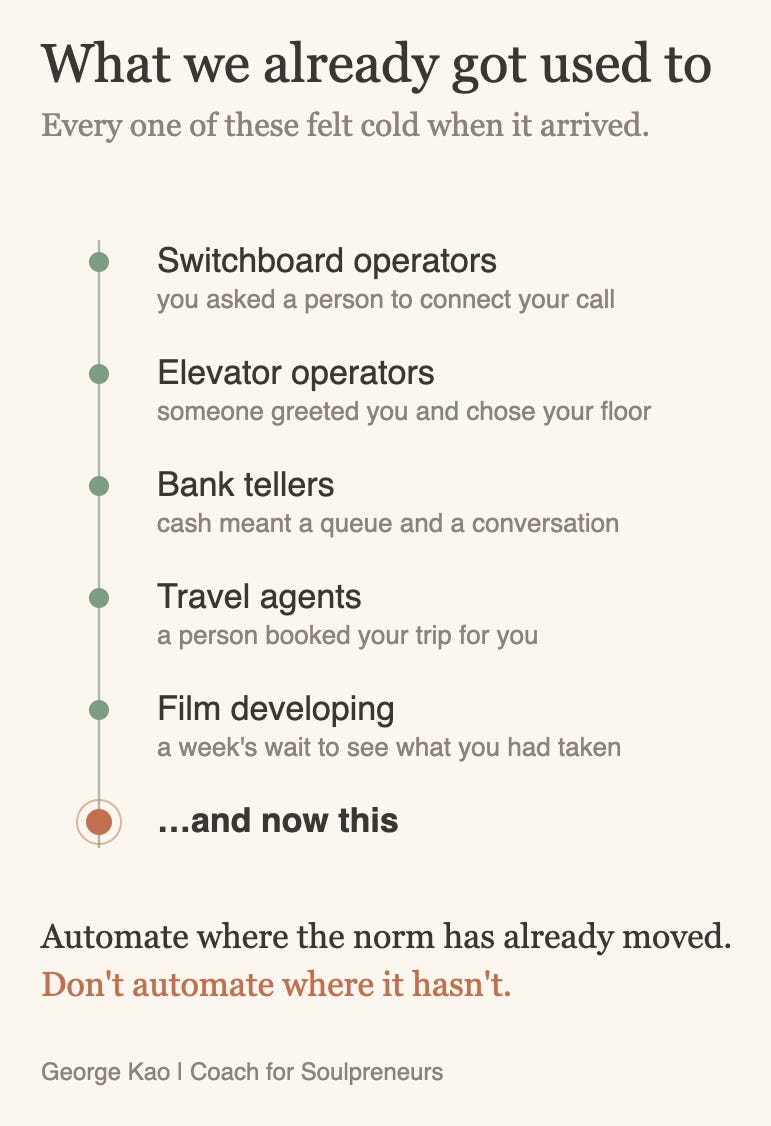
Think about the first automated elevators. There was no longer a human operator to greet you, to ask your floor, and to take you there — you now had to push your own button, alone, in a little room.
I’m sure it felt cold to a lot of people at the time.
Or, how about getting cash from an ATM instead of walking into the bank and talking with a friendly teller who knew your name?
We got used to both. What we used to do human-to-human became automated. So what? We ended up with extra time and attention to spend on what we care about more.
However, we shouldn’t automate what isn’t yet expected to be automated. When we do that, it lands as a withdrawal of care.
For example, if a friend receives an email from you that reads like a machine wrote it, they don’t experience efficiency — they experience it as "you spent none of yourself on me." And, they’re right to feel a sense of coldness, disconnection.
So the rule I try to follow: automate where the norm has already moved. Don’t automate where it hasn’t. I wrote about my own version of getting this wrong here.
What we lose… and what grows in its place
Marshall McLuhan said it in 1964, and I think he was right: every extension of a human faculty is also its amputation.
The car extended our legs, and drastically decreased our walking. Writing extended our memory, and devastated our ability to memorize words.
So yes, using AI will cost us capacities for sure. That’s how tools have always worked.
The first half of that sentence gets much less attention though — we cannot yet imagine the capacities we’re growing.
A few small examples show us what’s possible:
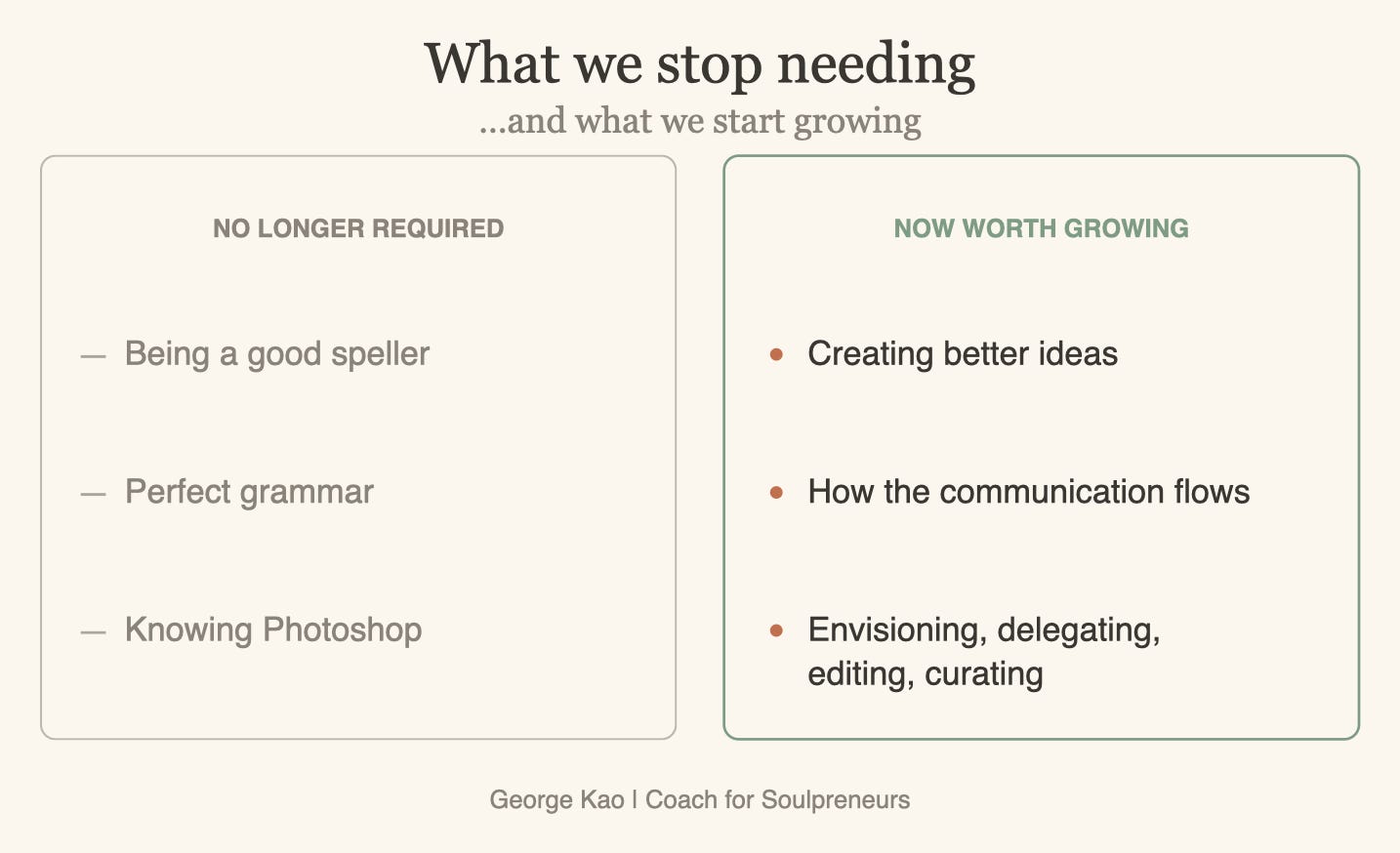
- We’re no longer required to be good spellers. We now get to focus on creating better ideas.
- Grammar used to take real effort; now that effort goes into how the communication actually flows.
- And, rather than learning to use photoshop for images, we’re now learning to envision, delegate effectively, to edit, and to curate.
Do we want to go back to before calculators? Before the screwdriver? Before the wheel?
I’d rather choose what I’m bored and frustrated by, than to have no choice about it.
Adding value has simply risen a level. You can’t add value anymore by manually adding up numbers for someone (a "calculator" used to refer to a human who does calculations), nor by finding an obscure fact in a library for them. That kind of administrative work moved up to the next level, and so did the people doing it.
It has cost me though…
I’m losing my patience for anything administrative. Claude handles so much of it now that I can feel the muscle going. You can see the large list of tasks that AI does for me here.
I’ve also lost the patience to write a blog post from scratch, by myself. Partnering with AI means I’m able to do a lot more research, more deeply, and also, hold more viewpoints than my own, and make something far more thorough than I could have made alone. I don’t want to go back. But I do notice what I traded.
The hardest one to admit is that my own AI (George Kao Bot) has served a lot of my users better than I could have myself. It draws its answers from strategies I’ve published over the years — and it contradicts itself less than I do. 😅
The cost has been real, too, not only philosophical.
My business has declined in the past 3 years because of AI. And that’s substantially my own doing, since I made my AI chatbot freely available — about as self-inflicted as a wound gets.
So… would I do it again?
Yes.
Because it has served far more people, in a customized way, than I could ever have myself. And analyzing the conversations as a whole (anonymously, without names shown) has also handed me lots of ideas for content and courses I wouldn’t have thought of on my own.
And, the spaciousness it opened up has let me explore how to add value above and beyond what AI does. I’ll keep sharing what I find, here in my articles, and in my courses.
What still troubles me
If those losses are "amputations", then perhaps some of the heebie-jeebies people currently feel about AI may be… phantom-limb sensations? 😅 The feeling of a faculty that used to be part of you, and now lives somewhere outside you…
I feel that some of what repels us is a genuine sense of violation… and yet, some of it may simply be unfamiliarity — and I can’t reliably tell which is which. And I don’t think most people can either. This is why I encourage us to hold those feelings a little more loosely.
What I do truly lament, is how fast AI has disrupted solopreneurs’ careers. Graphic designers. Copywriters. Coaches of every kind, and course creators, myself very much included, as people work things out with ChatGPT instead of buying a course or booking a session.
And, I also have to acknowledge the other side. It has become easy for us to get things done so much more cheaply. We can do more of our own graphic design. Our own copywriting. Or working through a mental stuckness any time of day or night, without needing to wait for an appointment.
Both sides are true. I don’t think either one cancels the other.
If interested in the more optimistic perspective, I wrote about how AI can free us for deeper work here.
Two things I’ll come back to
The elder who never dies. I’ve heard an interesting objection — that an AI trained on an elder’s life work means the elder never has to "die" — and how utterly unnatural that is…
The example that helps me think through this is Superman’s dad.
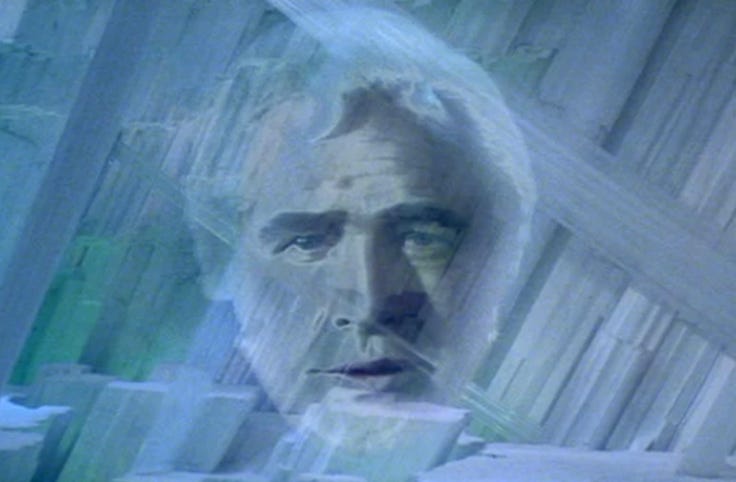
Jor-El, Superman’s dad, exists as an interactive presence who answers his son’s questions and walks him through his own history, and even has some power to affect the real world. Which is to say: an AI agent, before we had the phrase for it. The 1978 film hinted at it already — Clark returns to the Fortress of Solitude and consults his father’s hologram, who responds to what he’s feeling.
Nobody watching confuses it for his real dad. We understand the hologram as a representation of a real person that Superman can no longer touch. And what that carries is both grief and gratitude — that his parents had lived, and had generously left him a representation that could still comfort and guide him…
That inspires me. I’m in fact already building mine — the corpus of my whole body of work — my best ideas and perspectives pages, and my own public AI which will keep improving over time while I still can.
Whether we can still gather. The worry underneath a lot of this is that the village used to absorb a significant change together… and some lament that we don’t have the village anymore.
I don’t think that’s true. People are curating their own "villages" these days — masterminds, men’s groups, women’s circles, career-changer support groups, holistic retreats, sacred circles, churches, and so on. It’s easier than ever to find people to metabolize a change with, and easier than ever to bring an affliction to a group, and find understanding company and care.
And instead of needing each other, for transactional reasons (having to wait in line for a bank teller…) what if our needs were freed up enough by AI and automation, that we now have the spaciousness to want to be with each other? Out of sincere service, or simple delight, rather than obligation?
In-person gatherings are coming back into vogue, too. I think they’ll keep coming back as more of life moves onto screens. People are realizing the importance of touching grass, and touching humans.
What unwise use looks like
Using AI unwisely is like using any tool without thinking about how it fits your development as a person and a professional.
A student, still developing their grasp of language, who get their AI to write all their essays from start to finish, never practicing the writing, is using it unwisely. So are the teachers who allow it.
A business owner who has AI produce copy and design with no regard for their branding, is also using it unwisely — and their audience can easily sense the slop.
I hand over the admin I used to do by hand, so I have more time to think, and express more of what I actually think, and to research more deeply, and to make more things that serve my audience. And, to have the spaciousness to think deeply about how to prepare for a world where more and more human tasks are automated.
I also don’t mind that artists’ and writers’ work went into training these models — mine did too. What I feel is gratitude for what came before, and for how it’s being used now to help so many people. I’ve written more about that here.
Bring your wisdom into the using of it…
…and teach others how to use it wisely, because they’re already using it, or if not, they likely will be soon.
Any reluctance you have towards AI is a qualification, not a deficit. The people with the strongest instinct that something is at stake, are exactly the people whose hands belong on the norms of all this stuff. We need your reticence.
And if you’re the AI-enthusiast among your friends, here’s your answer for them: your hesitation is useful — please bring it — so it can be used more appropriately, and wisely.
Try drawing a line through your own work. On one side, what the machine may touch: the admin, the logistics, the heavy lifting of manual grind. On the other side, what it may not — whatever is sacred in your practice. Whatever only you should be the one to do, to say, to care about.
For ideas on what belongs on the machine’s side of that line, I’m putting together a free guide here (no opt-in required). It’s a list of what I’ve handed over so far, and what it gave back to me in time and spaciousness.
When synthesizers arrived, songwriters didn’t stop doing their work. They gained a new instrument. The machine can carry the notes — it can’t write your own heartfelt song.
Most of all, I wish we would take on curiosity for each other’s choices, rather than automatic denunciation and duality.
So — what do you wish I could see, or believe differently?
And when has an AI tool changed you, for better or worse? I’d love to hear that story in the comments.
May we each bring our full wisdom to the tools that are arriving… and may we stay tender with one another while we figure this all out. 🙏🧡
A note on how this article was made: AI systems are built to agree with you. So I convened an AI council and asked it to argue against me — including one voice that read my first draft and told me it was contemptuous, and would lose the very readers I was writing for. It was right. This is the rewrite. The final words are my own.
Visit the comments section here (and feel free to add yours!)
