The Five Qualities that Soulpreneurs Tend to Neglect

Over the years, so many of us who build heart-led businesses have experienced this: you close the tab on another “how I scaled to six figures in six months!” post, feeling like it alienates part of you.
Not because it’s wrong, exactly… but something deeply resonant was missing.
You know the values those posts run on. Resilience. Vision. Abundance. Leverage. Growth. Optimism. The time is now.
None of that is bad advice. But if you’ve ever finished one of those posts feeling more contracted instead of more free… it’s because it’s only half the picture.
The missing half
For a long time I’ve been curious about a question underneath all this: what are the true qualities of a flourishing human life? The kind that thousands of years of wisdom traditions — and modern psychology — keep arriving at independently.
I finally gave that question the time it deserved. Deep research, many rounds of it, more than fifty sources across 2,500 years. It grew into a framework of twelve qualities. (If you’d like the whole map, it’s here.)
From that research, I noticed something that’s important for us soulpreneurs.
Almost every “success” framework is built on a single axis — call it the agentic one. Act. Build. Expand. Optimize. Push.
It tends to leave out the other part — the receptive axis. Receive. Attend. Give. Wait. Be enough.
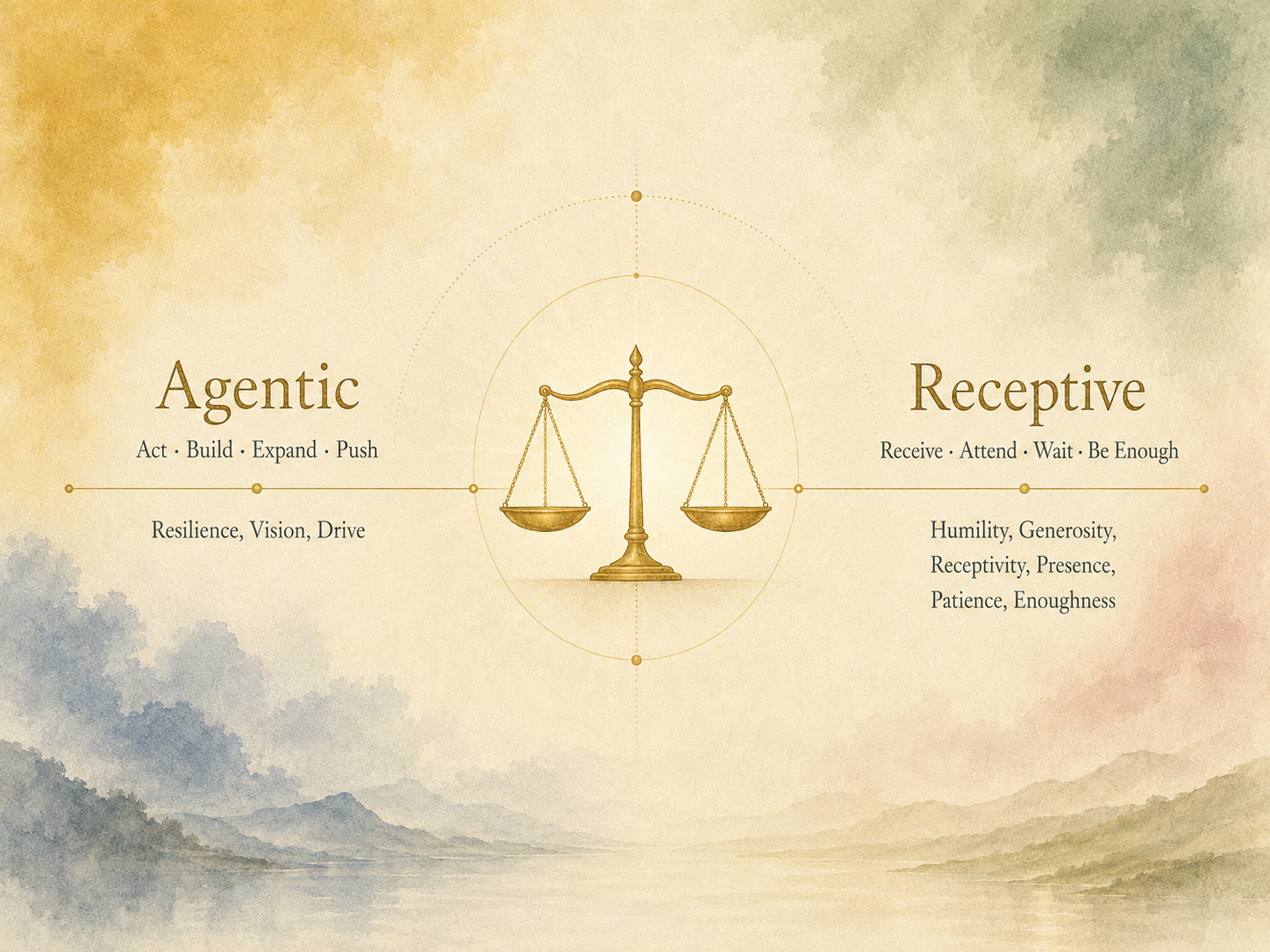
Nearly every quality that the hustle skips, lives over on that receptive side. And those are exactly the qualities a heart-led business — and our souls — most need to feel whole.
The agentic frameworks aren’t wrong. They’re a toolkit for a different purpose — for building big, fast. And they’re often good at it.
But the soulpreneur’s work isn’t necessarily optimized for bigness. It needs both hands: the one that reaches out, and the one that opens to receive.
Pay attention to the “near-enemy”
One idea makes all of this practical — maybe the most useful idea I came across in my research. It comes from Buddhist psychology, and it’s called the near-enemy.
Every quality has an obvious opposite — its far enemy. The far enemy of courage is cowardice. Easy to spot, and to guard against.
But every quality also has a near-enemy: it looks like the real thing, but it’s a clever counterfeit.
For example: people-pleasing wears the face of generosity.
Resignation can look just like contentment.
And self-erasure does a convincing impression of humility.
We rarely fall for a quality’s opposite… we fall for its counterfeit.
The five qualities soulpreneurs tend to neglect
If you lead with your heart, these may feel familiar — they’re the qualities we tend to let slide. Over-giving is kind of our signature move. 😅 These five are what keep it from burning us out.
1. Enoughness.
The felt sense that what you have, and who you are, is already enough — so you can serve from fullness instead of grasping from scarcity.
One caution first, because many of us are genuinely stretched: enoughness is not necessarily a call to charge less. Charge enough to sustain you and your family — please. The enoughness I mean is more inward — a sense that your life, looked at clearly, already holds enough to build on. That foundation is what the business guru’s endless more can never give you.
The old line from First Timothy puts it another way — “godliness with contentment is great gain.” Enough, truly felt, is already a kind of wealth.
Its near-enemy is scarcity dressed in spiritual clothes — and simple resignation, which can look a lot like peace from the outside.
2. Boundaries.
The “no” that protects the “yes.” The courage of the limit.
A service priced at zero — or at a price that’s too low — kept up too long, isn’t generosity. It just wears you down, slowly, until you can’t serve anyone anymore. The boundary is what keeps your generosity sustainable.
Its near-enemy is walls: rigidity posing as a healthy limit.
3. Receptivity.
The capacity to receive help, support, grace — as naturally as you give it. This is the over-giver’s missing half. You can’t pour from a cup you won’t let anyone fill.
Christian theology even has a name for this kind of receiving — grace: the sense that the deepest gifts come to us unearned, and the only failure is refusing what’s freely offered.
A small practice, this week: let someone help you without deflecting. Receive a compliment with your whole, open heart.
Its near-enemy is passivity calling itself openness.
Receptivity requires presence and engagement; it’s an active choice to let support in. Passivity, by contrast, is a defense mechanism. It might look like “going with the flow,” but it’s often a way to avoid the vulnerability of actually participating. True receptivity is an opening of the heart; passivity is often just a closing off, masquerading as surrender.
4. Self-compassion.
Love, turned inward — meeting your own failure the way you’d meet a dear friend’s.
For anyone who creates and puts their work into the world, this is the one that lets a missed day not become a quit day. When you slip, the kindest move is a hand on the heart — and pause the judgment.
Kristin Neff’s research confirmed what the contemplatives long knew: self-kindness is what sustains lasting change. The inner friend gets you further than the inner critic.
Its near-enemy is self-pity, which traps you in a cycle of wallowing. It also shows up as “slack” — a form of false kindness that lets you off the hook instead of helping you grow. Real self-compassion, like a hand on the heart, is deeply supportive but never permissive.
5. Patience.
The courage to wait — to let things ripen in their own time, without forcing them, and without abandoning them.
You scroll, and everyone else seems to be succeeding already, while your own work is still finding its people. Soulpreneurship is a long game. Most heart-led work grows slower than the biz gurus want you to believe.
Its near-enemy is procrastination calling itself patience — and passive resignation doing the same.
Is your business even compatible with your soul?
There’s one tension we live every single day, and it sits under most of the others:
How do I let my work be found… without turning into someone I don’t want to be?
For clarity, run it through the near-enemy lens. Humble visibility is simply the service of your work, made findable — which is most of what I mean by authentic business. Its counterfeit is self-aggrandizement, making it all about you.
And the other side of this catches sensitive people especially: letting your good work stay invisible isn’t humility either. That’s the near-enemy of humility — self-erasure — just with better PR.
2,500 years ago, the Buddhist teaching of Right Livelihood already clarified the wrong kind of selling: “scheming, persuading, hinting, belittling, pursuing gain with gain.” A near-enemy list for marketing, written well before the era of marketing!
Which is really the tradition answering the anxious question underneath all of this — can I run a business and still keep my soul? The answer, a long time ago, was yes. There’s a middle way… neither hustling for reach, nor waiting forever to be discovered.
I know that middle way all too well, because I didn’t begin there. For the first few years I hustled — pushing, forcing, doing all the things the gurus prescribed. It made me feel at odds with my conscience, and burned me out. Only when I found a gentler way of working did my “business” become something more like a wholesome expression.
I’ve made my full-time living with “authentic” business for more than a decade, and still — some mornings I catch myself refreshing the numbers, reaching for more. The pull never fully leaves — the practice is simply in returning…
How these grow — gently
A quality you admire changes nothing. A quality you practice, though, gradually becomes you. Aristotle revealed the mechanism long ago: you don’t decide to be patient — you become patient by practicing patience, in a hundred small moments, until one day it has become second nature.
And that practice happens somewhere specific — not on a meditation cushion, then back to “real life.” It happens in the work. When you show up to create, consistently, even though no one’s watching yet. In the launch that meets silence. Yet you gently get back up, and trust the process again.
The work becomes the dojo. Every ordinary task is a rep (fitness term for repetition) for some quality. (That’s the point underneath Joyful Productivity — the work was never only about the output. It’s also about who the work is turning you into.)
One caution, though — and it’s the people who care most about growing who are most at risk. We can easily take a quality, turn it into a measuring stick, and beat ourselves with it… I should be more present. I should be more generous. Why am I still like this?
That guilt is the near-enemy of growth.
The quality you’re weakest in isn’t your shame. It’s your curriculum. You’re not behind… you’re fully enrolled!
I often encourage my clients (and myself) to practice being strict about showing up, lenient about the results, and gentle about returning. The gentleness is what keeps it all sustainable.
Your turn…
Take these as invitations to notice which qualities your soul may have come here to grow.
To begin, pick one quality — ideally one whose near-enemy you’ve recently recognized in yourself — and reflect on it for a week. Not to try to fix yourself. To meet your soul with a warm welcome.
If you’d like the whole map — all twelve qualities, and where they come from — the full piece is here.
And I’d love to hear from you in the comments:
Which of these qualities feels most resonant for you to explore at this time? 🙏🧡
Visit the comments section here (and feel free to add yours!)
