Hard to focus? It isn't about discipline...

You’ve tried the timers. The 90-minute block everyone swears by, the perfect morning routine, the system a podcast promised would change your life.
And somewhere along the way — maybe after the third or fourth setup stopped working — a sneaky thought came: the problem must simply be me… my character… my willpower.
I know that disempowering thought all too well. Have heard it in my mind (and from authoritative figures) all my life.
I now see that it’s a lie.
“I just need more willpower” is the most seductive wrong story we can tell about: a body that needs sleep… a nervous system that needs to be restored… a transition that needs a cleaner boundary… or an environment that needs better design.
Most of what we call a focus problem is really a transition problem, a state-regulation problem, or a design problem that only looks like a willpower problem.
Focus is a state, not a virtue…
We talk about focus as if it were a trait — something you either have or lack, like height. He’s so disciplined. I’m just scattered.
But the research shows that focus doesn’t behave like a trait. It is a state that you enter, sustain, lose, and recover — many times in a single day.
And that state sits downstream of your nervous system. When your body feels overwhelmed, distraction shows up as protection — a pull toward something easier and safer. Your nervous system is trying to help you.
What a perspective shift that was for me! Instead of what’s wrong with me, we get to ask what does my state currently need. Permission, relief, dignity… before we try applying any tactic.
The three states to be aware of…
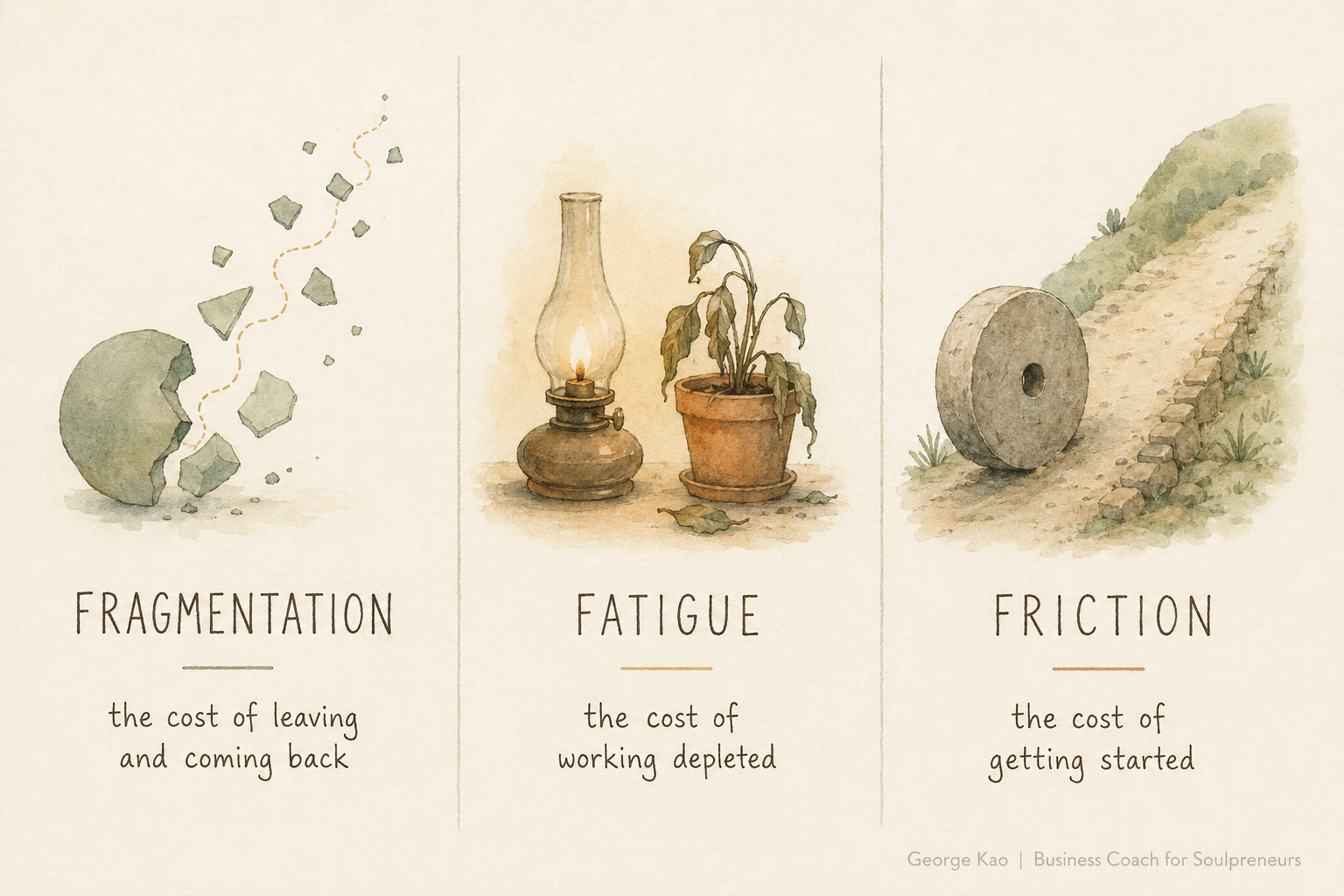
“I can’t focus” usually means one of three different things, and they don’t share the same remedy:
Fragmentation is the cost of leaving and coming back. Every switch — the glance at the phone, the “quick” inbox check — leaves a residue of attention on the thing you just left, so you’re never fully on the new thing. (Yes, even that five-second peek!)
Fatigue shows up when you try to work depleted. Sleep debt, a dysregulated nervous system, low blood sugar, hormonal phase… all of it lowers the ceiling on what any technique can reach.
Friction is the drag at the very start, and again at every re-entry. The blank page, the cold open, the long ramp into a deep interest before it turns absorbing.
The point is simple: these three issues require different solutions. Treating them as one problem is why so much “focus” advice hasn’t helped.
So before you reach for a tool, name which one is happening. Are you fragmented because you keep switching… fatigued because you’re running on too little sleep… or experiencing friction because beginning feels like pushing a stalled car? Different question, different answer.
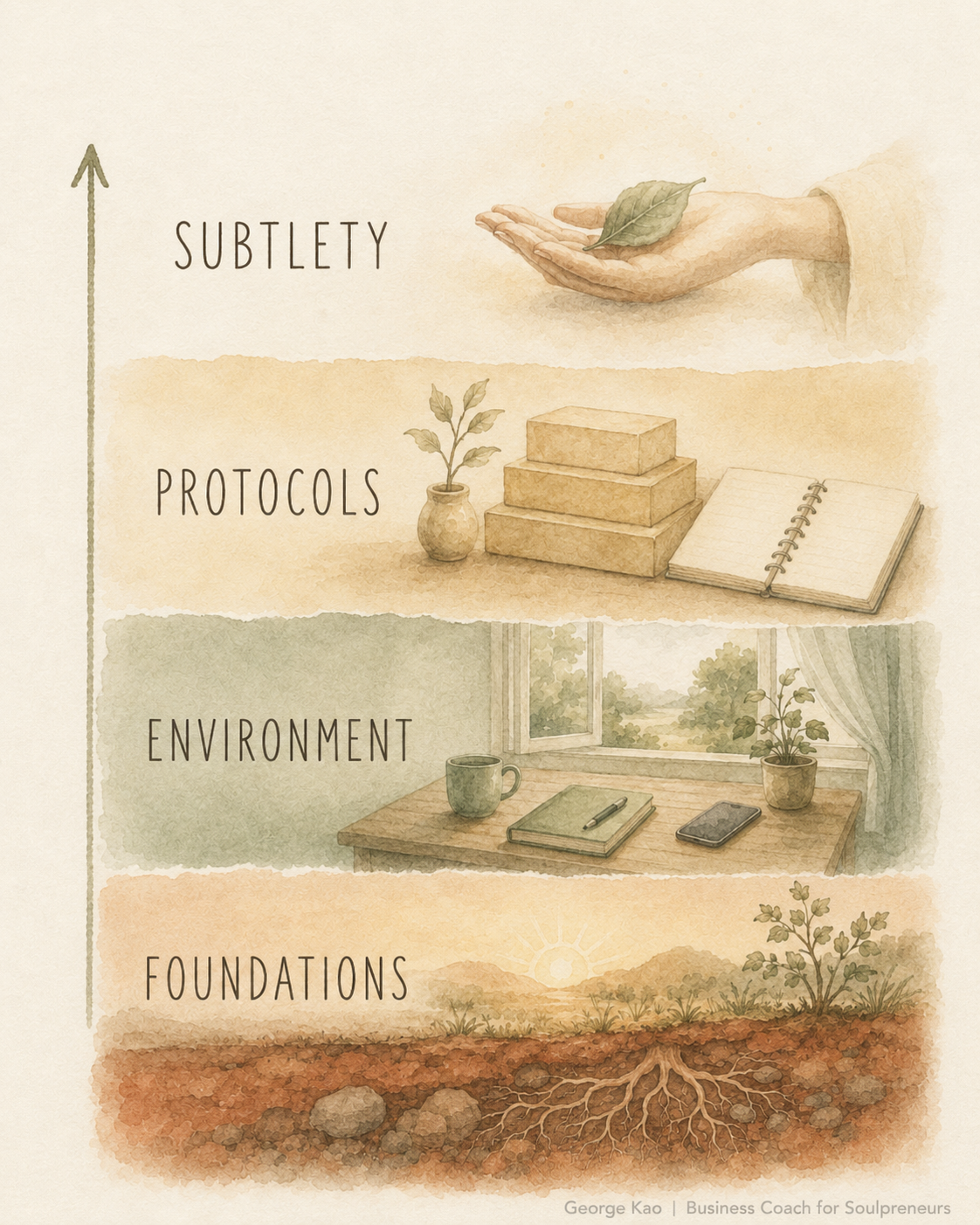
And if you say “what about all 3? 😅” you’ll see the proposed solution further down in this article: Foundations → Environment → Protocols → Subtlety is the recommended path.
The foundational lever:
Sleep. Morning light. Movement. Breath. Awareness of blood sugar. These set the ceiling for everything else. Skip them, and the most elegant productivity system is merely some decoration on a depleted instrument.
For example, research shows that chronic six-hour nights tend to produce attention impairments for a lot of people that are similar to having a night or two of no sleep at all — even while the person feels completely fine. You don’t notice the deficit. You just underperform, and assume it’s you.
So the soulpreneur running on six hours, certain they simply lack focus, is often performing like someone who pulled an all-nighter… and blaming their character for it.
And the debt is slow to repay… a couple of good nights won’t undo a week of short ones.
This is why elaborate focus systems never quite work for so many of us. They’re trying to solve an attention problem that’s actually a state problem.
It’s the state your body and brain are working in — and a state is a far more workable thing to change!
The 4-part process:
The most common mistake is reaching for the newest, most novel protocol first — the breathing technique, that new shiny app, the motivational video that a friend posted this week.
Based on the research, the following process (in this order) is the most effective:
- Foundations — sleep, morning light, aerobic movement, paced breathing when you’re keyed up, steady blood sugar. The state layer, first.
- Environment — phone displacement, hard-lock blockers, a workspace designed for focus, body-doubling (focusmate) if starting is your bottleneck. Most of the time, changing the room works better than out-muscling yourself inside a stuffy one.
- Protocols — single-task blocks, a capture sheet for stray thoughts, an end-of-block note, a shutdown ritual.
- Subtlety — the inner moves: labeling what you feel, writing down what’s eating bandwidth, a values reminder, the reframes (shared below).
Much “focus” advice starts at layer four, or three, or two… and never mentions layer one.
Remember: one habit change at a time. If you try to do it all at once, chances are that nothing will stick. One (small) change a week, secured, will carry you further over a year than a dozen changes attempted in a single month.
A starter menu — take what fits, leave the rest:
Not a catalog to complete. A handful of the higher-leverage moves, sorted by where they live. Try one from wherever you feel most stuck.
Foundations
- Morning sunlight, 10+ minutes within an hour of waking. The single highest-leverage daily lever on your state… and free.
- Aerobic movement, 20–40 minutes. It sharpens executive function for hours afterward, and it’s strangely missing from most focus advice. (Not for you if your body is asking for rest today — read the signal!)
- A protected sleep window — roughly the same bedtime and wake time, defended like an appointment, ideally 8 hours. After the six-hour finding above, this is the foundation beneath the foundations.
- A real meal before your hardest block. Steady blood sugar keeps the floor under your attention; an empty tank fades fast, and you’ll blame your focus for it.
Environment
- Phone displacement — another room, or a drawer. The cost isn’t the phone sitting there so much as the frequent checking, so distance is what does the work. Here’s my own setup, refined over years: airplane mode, always. Do Not Disturb on. And my phone number is a GoogleVoice account, so that calls still work on airplane mode. This all may sound extreme, until you feel how much bandwidth it frees…
- A hard-lock blocker on the sites and apps that pull you — one you can’t disable in two taps. The point is to make the easy escape route slightly harder than the work itself.
- Body doubling — working alongside someone, in the room or on a video call — try Focusmate or my work retreats. For those of us who work solo, the simple presence of another working human does more for getting started than any amount of self-talk.
Protocol
- A single-task block with a capture sheet beside you — when a stray thought arrives, you park it on the sheet instead of acting on it. This is the spine of my own days: my long-running Capture → Categorize → Calendar method. Any important thought or insightful idea gets caught onto my to-do list, so I don’t have to hold it… or chase it.
- An end-of-block closure note — the last 3–5 minutes, write what you decided and the exact next action, and leave it visible. It clears attention residue before it can follow you out the door. For us soulpreneurs, this was never about memorizing — we write everything down already. What it buys us is closure, plus an easy way back in, while still honoring what’s on the calendar.
- A simple shutdown ritual at the end of the workday — a short, repeatable sequence (close the tabs, jot tomorrow’s first move, take one breath of completion) that tells your nervous system the work is set down for now.
Subtlety
- An implementation intention plus a minimal start — “When I sit down with my tea, I open only [this one file] and write one sentence.” You’re not committing to the mountain. Just the first step onto it.
- Containment writing, about 10 minutes — write down what’s pulling at you, close the notebook, begin. It clears working memory so the worry isn’t running in a background tab.
- Block length matched to your energy — a fresh morning might hold 90 minutes; a depleted afternoon might give you 25. Sizing the block to the day you actually have beats forcing the block the productivity gurus prescribe.
- Urge surfing — when the pull to check something rises, name it, watch it crest, and let it pass without acting. The “noonday demon” (see below) always eventually fades on its own.
- One daily no-input interval — a walk, a chore, with no earbuds and no podcast. It protects the wakeful-rest window where synthesis and a sense of direction arrive.
For us soulpreneurs — reframes that improve the inner relationship
These sharpen how you think more than they prove a mechanism, so hold them loosely as perspective. Still, they’ve shifted how I relate to my own attention more than any tactic has.
Monotropism. Some minds run attention like a single deep channel, pouring into one narrow tunnel at a time. Many mission-driven solo operators run close to this, whether by neurology or by years of immersion in one body of work. If that’s you, generic “reduce switching” advice undershoots. What you need is tunnel protection: ruthless single-interest blocks, small rituals for entering and leaving the tunnel, and a breadcrumb so you can find your way back in.
Acedia, the “noonday demon.” Long before phones, desert monastics described a restless midday urge to leave the cell, to go check the horizon, to be anywhere but here. The pull to scroll your phone is ancient human territory, not a modern defect! Naming it that way removes the shame, and the shame is half the problem. 🙏 Just like the faithful monastics did: acknowledge the urge, then gently return to your post. Strict about showing up, lenient about the results, gentle about returning.
Two kinds of attention. Client work and course-building aren’t the same mode. Helping someone needs a broad, receptive attention, taking them in. Building something needs narrow precision. “Deep work” only describes the second kind. Both are real focus; both are worth protecting.
Work in seasons. A self-employed soulpreneur is one of the few people alive with the autonomy to structure output across the year — heavier months, lighter recovery months — instead of forcing the same yield every week. Most of the working world can’t. We can.
The empty bandwidth. Constant input fills the very bandwidth that soul-level integration needs. So leave some of it empty. The deeper work arrives in that space.
What to expect
The goal here, for us soulpreneurs, was never “maximum output”. You’re learning which levers — in your nervous system, your life — produce the biggest drop in fragmentation, fatigue, friction… and the easiest way back into work that matters most to you.
That’s a slower win than the productivity world sells… and a much more durable one!
No fantasy timelines. No thirty-day transformation. Just the gradual, patient work of finding what sustains your purposeful work and well-being long-term.
A four-week starter experiment:
If you want a way in, here’s a month you could run as an experiment — one move a week, nothing more:
- Week 1 — Foundations. Morning sunlight upon waking for 5 minutes, plus one daily no-input 10 minute walk.
- Week 2 — Environment. Phone in another room for your longest deep-work block of the day.
- Week 3 — Protocol. An end-of-block closure note on every work session, 3–5 minutes to close.
- Week 4 — Subtlety. Containment writing on the days that feel scattered.
Run it loosely, as an experiment. Track what shifts. Keep what works… and leave the rest!
What the focus is for 🧡
It helps to remember, at the end of all this, what the focus was ever for. Steadier contact with the work that’s yours — the work your soul keeps yearning to return to.
Seen that way, focus stops being a virtue you’re failing at. It becomes a form of devotion. The mission is the point… and focus is simply how you keep showing up for it, one ordinary block of time after another.
So pick one move this week. Just one. Run it, watch what changes, and let that teach you the next.
And if practicing this alongside other soulpreneurs would help — people learning the same thing and steadying each other — you might explore JoyPro, where we practice this kind of focus together.
May the work that matters most to you have the protection of these practices. 🙏🏼🧡
Visit the comments section here (and feel free to add yours!)
